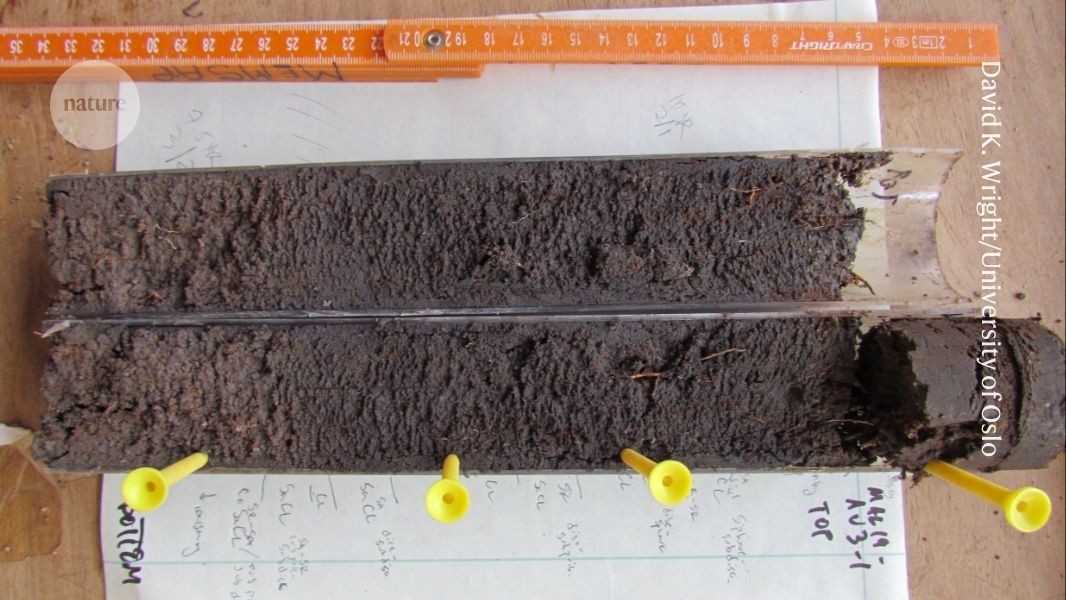
"These swamps surround Mount Hora, a granite hill located about 60 kilometres west of Lake Malawi, which separates the country from Mozambique and Tanzania. The site has a rich history, from the oldest-known human cremations roughly 9,500 years ago to 2,000-year old iron-smelting sites. The muddy layers of accumulated organic material, Wright hoped, would hold further clues about ancient groups of people."
"Wright's particular interest was more scatological: coprostanol, a molecule in human faeces that could shine a light on human population trends. "They're durable little suckers," Wright says of such biomarkers. Combined with other evidence, "you get a much clearer picture of what there was in the past"."
"Archaeologists have long focused on bones and other relatively macroscopic artefacts, but they are now teaming up with geochemists, palaeoecologists and biologists to unearth molecular lines of evidence. Technological and methodological advances over the past few decades have made it possible to detect minute traces of organic material."
Environmental archaeologist David Wright conducted fieldwork in northern Malawi swamps near Mount Hora, a granite hill with significant archaeological history spanning 9,500 years. Using percussion augers to extract mud cores from leech-infested swamps, Wright and colleagues sought molecular evidence preserved in sediment layers. The site's rich history includes the oldest-known human cremations and 2,000-year-old iron-smelting sites. Wright focused on coprostanol, a molecule found in human feces that serves as a biomarker for understanding ancient population trends. Modern archaeology increasingly combines traditional artifact analysis with molecular evidence from geochemists, palaeoecologists, and biologists, utilizing technological advances to detect minute organic traces.
#environmental-archaeology #molecular-biomarkers #ancient-population-studies #interdisciplinary-archaeology #mount-hora
Read at Nature
Unable to calculate read time
Collection
[
|
...
]