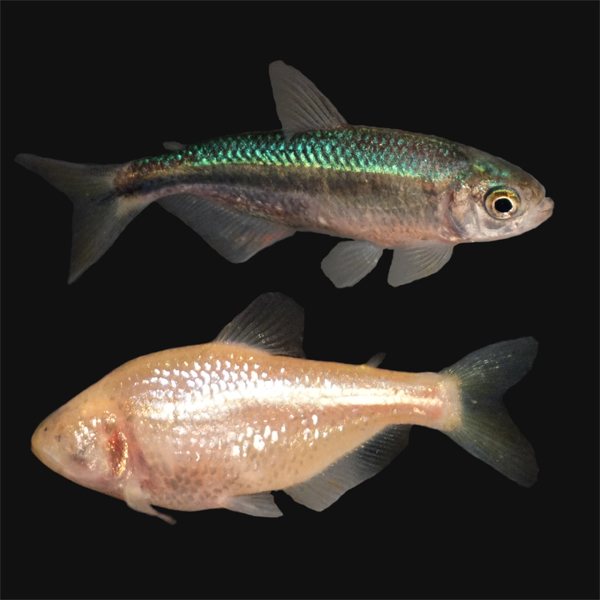
"Time and again, whenever a population was swept into a cave and survived long enough for natural selection to have its way, the eyes disappeared. "But it's not that everything has been lost in cavefish," says geneticist Jaya Krishnan of the Oklahoma Medical Research Foundation. "Many enhancements have also happened." Though the demise of their eyes continues to fascinate biologists, in recent years, attention has shifted to other intriguing aspects of cavefish biology."
"It has become increasingly clear that they haven't just lost sight but also gained many adaptations that help them to thrive in their cave environment, including some that may hold clues to treatments for obesity and diabetes in people. Casting off expensive eyes It has long been debated why the eyes were lost. Some biologists used to argue that they just withered away over generations because cave-dwelling animals with faulty eyes experienced no disadvantage."
"But another explanation is now considered more likely, says evolutionary physiologist Nicolas Rohner of the University Münster in Germany: "Eyes are very expensive in terms of resources and energy. Most people now agree that there must be some advantage to losing them if you don't need them." Scientists have observed that mutations in different genes involved in eye formation have led to eye loss. In other words, says Krishnan, "different cavefish populations have lost their eyes in different ways.""
Repeated cave colonization by Mexican tetras led to loss of eyes because vision provided no benefit and eye tissues impose high energetic costs. Multiple independent mutations in distinct eye-development genes produced eye degeneration across populations. At the same time, nonvisual systems were strengthened: cavefish detect lower amino acid concentrations, develop more tastebuds, and possess denser lateral-line sensory cells. Brain regions for nonvisual processing have expanded. Natural selection favored energy-saving eye loss and sensory reallocation. Some evolved metabolic and sensory traits offer parallels to human conditions and could provide insights relevant to obesity and diabetes research.
Read at Ars Technica
Unable to calculate read time
Collection
[
|
...
]