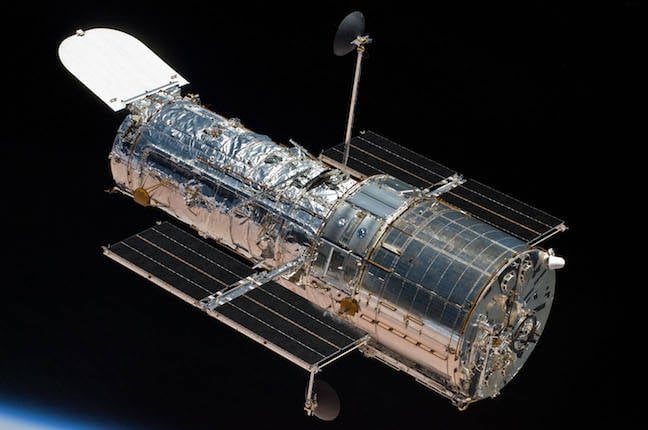
"From an initial altitude of more than 600 km, Hubble is now well below 500 km. The more rapid descent in recent years is at least partly due to increased solar activity, which has caused Earth's atmosphere to expand, but it also highlights the need for a reboost in the next few years before the telescope becomes unrecoverable."
"While it remains capable of pointing its instruments and has returned breathtaking imagery over more than three decades in orbit, it cannot raise its altitude. The observatory was serviced by a succession of Space Shuttle crews over the years, and engineers worked around hardware failures as the observatory aged. However, no amount of ground-based cleverness will stop the spacecraft from eventually re-entering the atmosphere."
"Unlike Swift, Hubble was designed to be captured and serviced in space, and the last Space Shuttle servicing mission left an adapter attached to the vehicle for a future visiting spacecraft."
The Hubble Space Telescope has descended significantly since its 1990 launch, dropping from an initial altitude of over 600 km to below 500 km. Recent orbital decay has accelerated partly due to increased solar activity expanding Earth's atmosphere. Unlike the aging observatory's previous servicing by Space Shuttle crews, no current mechanism exists to raise its altitude. NASA is exploring reboost options, with administrator Jared Isaacman previously proposing a rescue mission. Hubble's design includes an adapter for future visiting spacecraft, making a reboost technically feasible. However, the observatory faces additional challenges beyond orbital decay, including budget constraints and aging hardware.
Read at Theregister
Unable to calculate read time
Collection
[
|
...
]