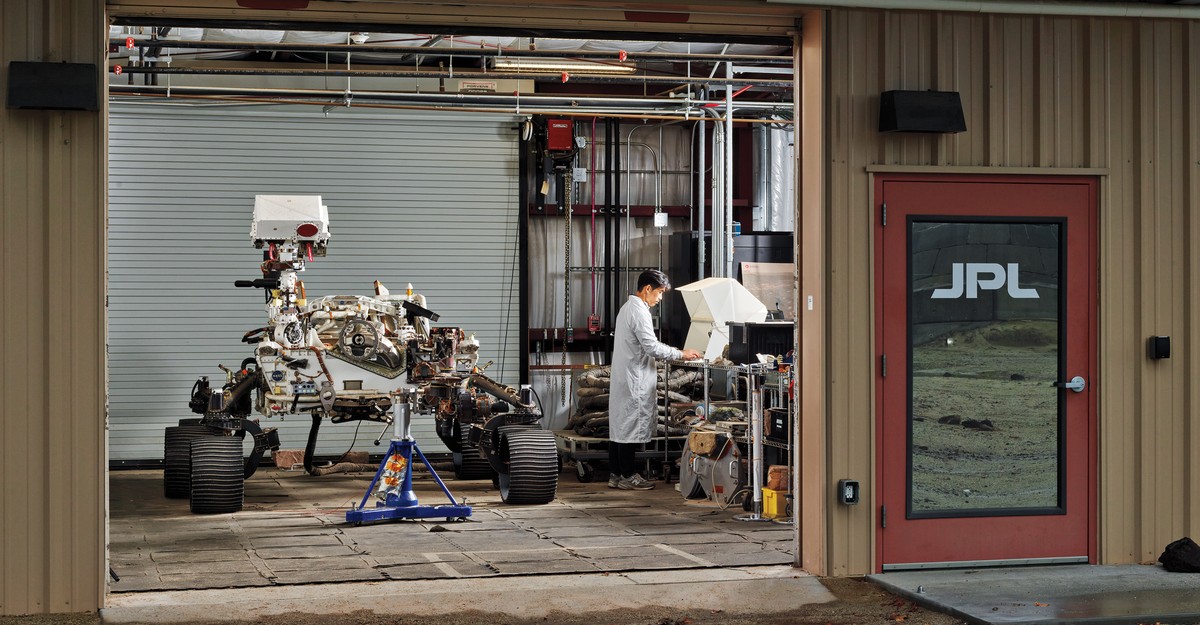
"On Mars, in the belly of a rover named Perseverance, a titanium tube holds a stone more precious than any diamond or ruby on Earth. The robot spotted it in 2024 along the banks of a Martian riverbed and zapped it with an ultraviolet laser. It contained ancient layers of mud, compressed into shale in the 3.5 billion years since the river last coursed across the red planet."
"The rover tucked a core sample about the size of a piece of chalk into a treasure chest in its chassis. There the rock will remain until a future robot parachutes down onto the Martian surface, grabs the chest, and launches it back to Earth. If scientists are able to inspect it in person, and they find that Mars was indeed once alive with microbes,"
"At NASA, it paid for hundreds of spacecraft that have flown past all of the solar system's planets, dropped into orbit around most of them, and decelerated from flight speed to reach the surface of a few. These missions have disclosed the scientific qualities of other worlds, as well as the look and feel of them, to all humanity, and for posterity too."
Perseverance collected a chalk-sized core of ancient shale from a Martian riverbed and detected organic compounds and leopard-like spotting patterns similar to microbially altered muds on Earth. The sample was sealed inside a titanium tube and cached in the rover's chassis for a future retrieval mission that would return it to Earth for laboratory analysis. If returned samples confirm past Martian microbial life, that would imply life is not unique to Earth and likely arose elsewhere in the galaxy. NASA has invested roughly $60 billion over almost 60 years in interplanetary robotic missions, most Mars landings were managed by the Jet Propulsion Laboratory, and these missions have revealed other worlds' scientific properties and appearances for humanity and posterity.
Read at The Atlantic
Unable to calculate read time
Collection
[
|
...
]