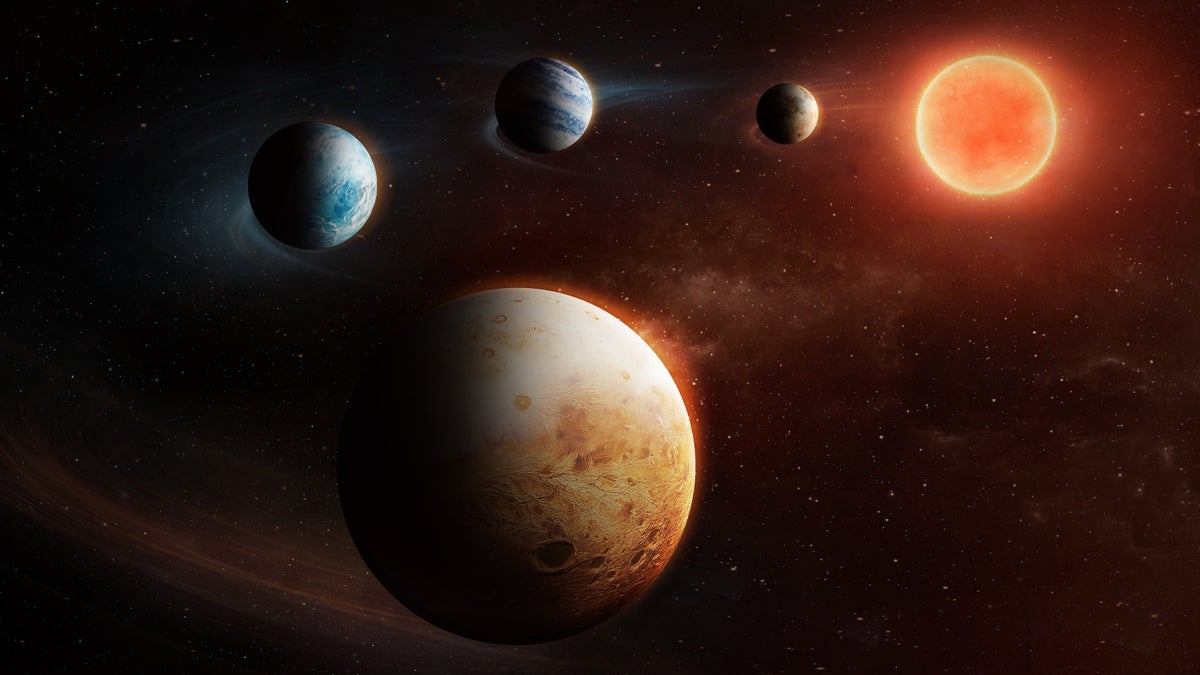
"Researchers have found that this same pattern holds for many other planetary systems, and they typically explain it as outer worlds bulking up on ice, gas and dust that's more abundant farther out from baby stars. But now a global team of astronomers led by Thomas Wilson, an astrophysicist at the University of Warwick in England, has discovered a planetary system that seems to have been built inside out, with bigger worlds closer in capped by a smaller one farther out."
"Their observations of a faint, cool M-dwarf star called LHS 1903 revealed a system with a rocky world at its outer edge. LHS 1903 is an ancient star, around seven billion years old, and only has about half the mass of our sun, but at first glance its arrangement of planets appeared somewhat similar to our own. NASA's Transiting Exoplanet Survey Satellite (TESS) had spotted three planets there called LHS 1903 b, c and d."
LHS 1903, a faint, cool M-dwarf roughly seven billion years old and about half the Sun's mass, hosts four confirmed planets. The innermost planet, LHS 1903 b, is a dense rocky super-Earth. Planets c and d are sub-Neptunes with thick gaseous atmospheres located farther out. A fourth planet, LHS 1903 e, was detected near the system's outer edge and is rocky. The arrangement shows larger, gas-rich worlds closer to the star and a smaller rocky world farther out, the reverse of the standard model where icy outer regions produce bigger planets. The configuration implies alternative formation or migration histories in some planetary systems.
Read at www.scientificamerican.com
Unable to calculate read time
Collection
[
|
...
]