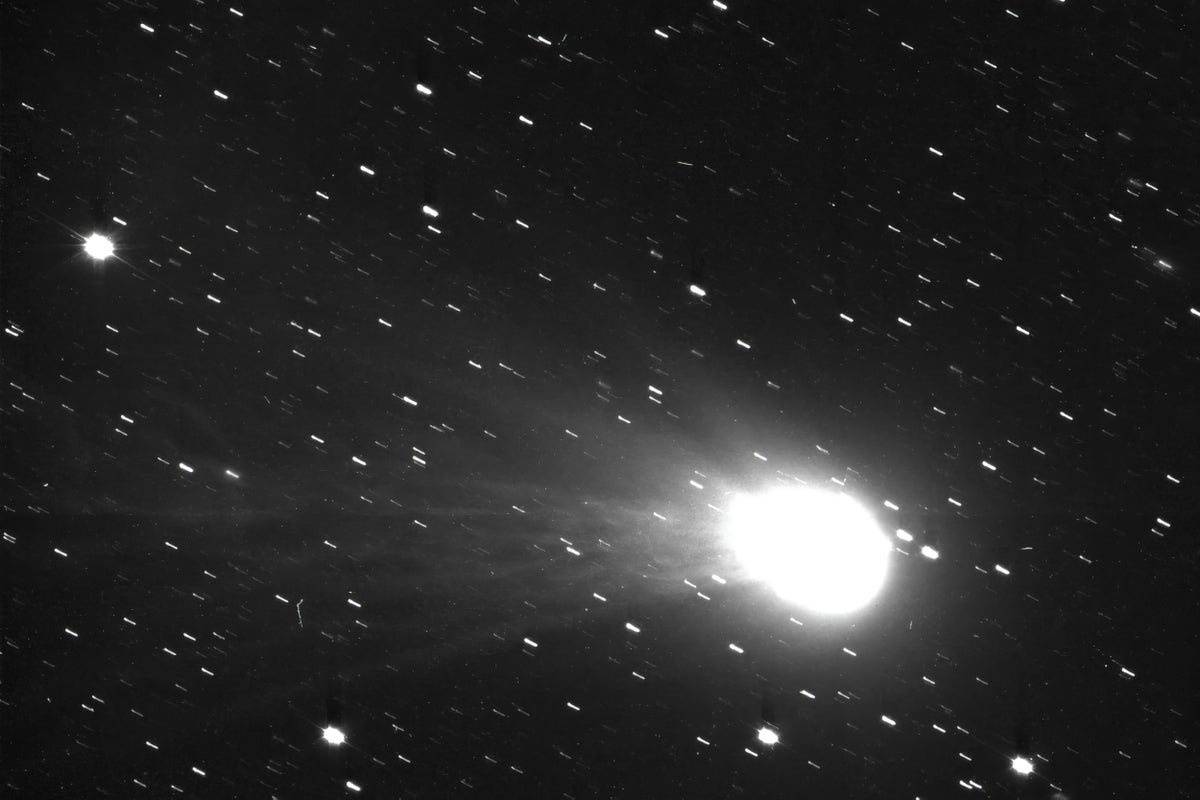
"In late 2025 a mysterious comet flew between the orbits of Earth and Mars and reached a speed of more than 150,000 miles per hour during its closest approach to the sun. The rare interstellar guest to our solar system captured astronomers' attention, and many trained their observations onto it in a bid to understand what exactly it is, why it is here and where it might be going."
"a new image of the comet captured last November by the Jupiter Icy Moons Explorer, or JUICE, reveals it to be almost egg-shaped, with a cloud of gas veiling its central core, or nucleus. While 3I/ATLAS is a visitor from interstellar space, travelling from outside the Solar System, its behaviour is completely in line with that expected from a normal' comet, the agency said in a statement."
"No one knows where the comet came from, said David Jewitt, director of the Institute for Planets and Exoplanets at the University of California, Los Angeles, in a statement last year. You can't project that back with any accuracy."
In late 2025, a rare interstellar comet designated 3I/ATLAS passed through our solar system between Earth and Mars orbits, reaching speeds over 150,000 miles per hour at its closest approach to the sun. Astronomers worldwide directed observations toward this mysterious visitor to understand its composition, origin, and trajectory. The European Space Agency's Jupiter Icy Moons Explorer spacecraft captured images revealing the comet's nearly egg-shaped nucleus surrounded by a gas cloud. Despite originating from interstellar space outside our solar system, the comet exhibits behavior consistent with typical comets. Scientists acknowledge uncertainty about the comet's origin point, as accurate backward projection of its trajectory remains impossible.
Read at www.scientificamerican.com
Unable to calculate read time
Collection
[
|
...
]