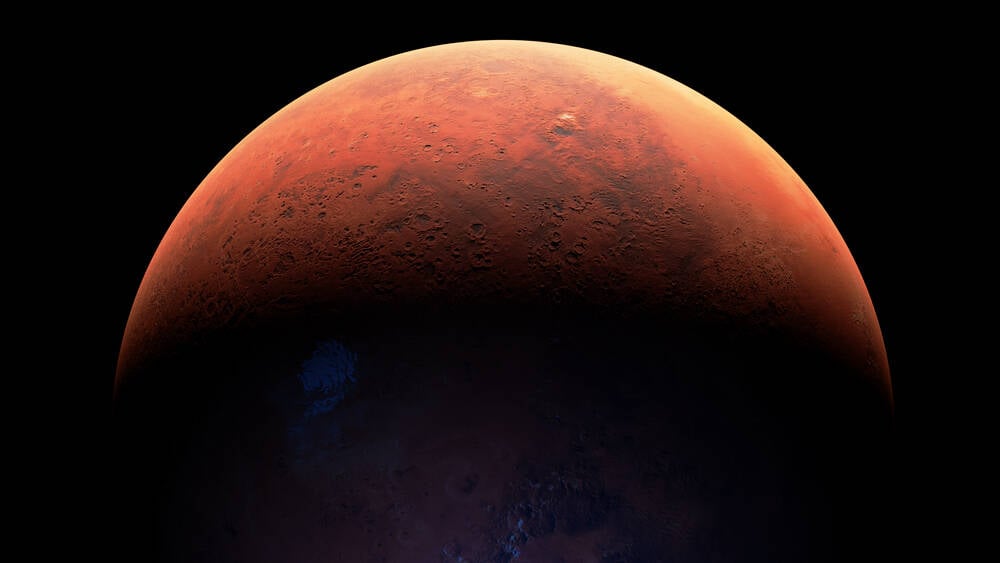
"The superstorm caused a dramatic increase in electrons in two distinct layers of Mars's atmosphere at altitudes of around 110 and 130 km, with numbers rising by 45 percent and a whopping 278 percent, respectively. This is the most electrons we've ever seen in this layer of Martian atmosphere."
"Luckily, the spacecraft were designed with this in mind, and built with radiation-resistant components and specific systems for detecting and fixing these errors. They recovered fast."
"It's only in the past five years or so that we've started using it at Mars between two spacecraft, such as Mars Express and TGO, which usually use those radios to beam data between orbiters and rovers. It's great to see it in action."
Nearly two years ago, a powerful solar storm reached Mars and affected ESA's Mars Express and ExoMars Trace Gas Orbiter spacecraft, causing temporary computer errors but triggering valuable scientific observations. Using radio occultation—where Mars Express transmitted signals to TGO as it passed over the Martian horizon—scientists measured dramatic increases in atmospheric electrons at altitudes around 110 and 130 kilometers, with electron densities rising by 45 and 278 percent respectively. This represented the highest electron concentrations ever recorded in that atmospheric layer. The technique, traditionally used for decades with Earth-based receivers, has only recently been applied between two Mars orbiters. NASA's MAVEN mission provided confirmatory observations of these electron density measurements.
Read at Theregister
Unable to calculate read time
Collection
[
|
...
]