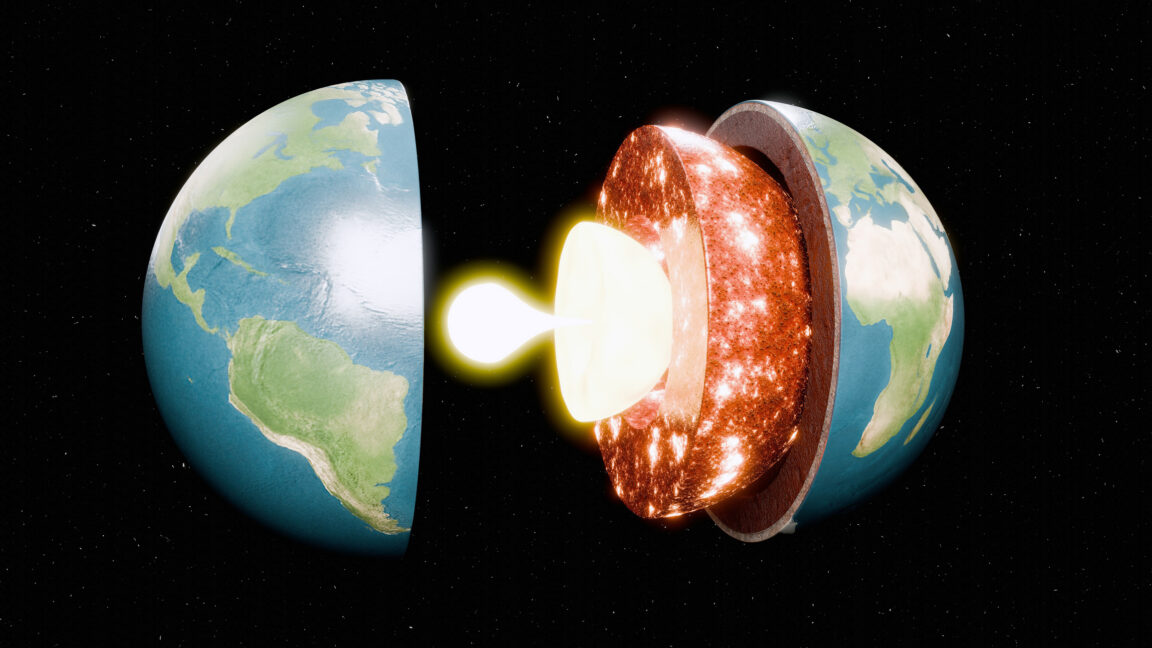
"Recently, a team of scientists reported a possible explanation-that the elements are hiding deep in the solid inner core of Earth. At its super-high pressure-360 gigapascals, 3.6 million times atmospheric pressure-the iron there behaves strangely, becoming an electride: a little-known form of the metal that can suck up lighter elements. Study coauthor Duck Young Kim, a solid-state physicist at the Center for High Pressure Science & Technology Advanced Research in Shanghai,"
"Electrides, in more ways than one, are having their moment. Not only might they help solve a planetary mystery, they can now be made at room temperature and pressure from an array of elements. And since all electrides contain a source of reactive electrons that are easily donated to other molecules, they make ideal catalysts and other sorts of agents that help to propel challenging reactions."
Earth shows large deficits of light elements and noble gases relative to the Sun and some meteorites. At inner-core pressures around 360 gigapascals, iron can form an electride phase that sequesters hydrogen, carbon, nitrogen, sulfur and noble gases. Progressive absorption over billions of years could account for a 5–8% lower inner-core density inferred from seismic waves. Electrides are now synthesizable at ambient conditions and contain readily donated electrons, making them powerful catalysts. One electride already catalyzes ammonia production with about 20% lower energy use than conventional methods, and new electrides are under discovery for other reactions.
Read at Ars Technica
Unable to calculate read time
Collection
[
|
...
]