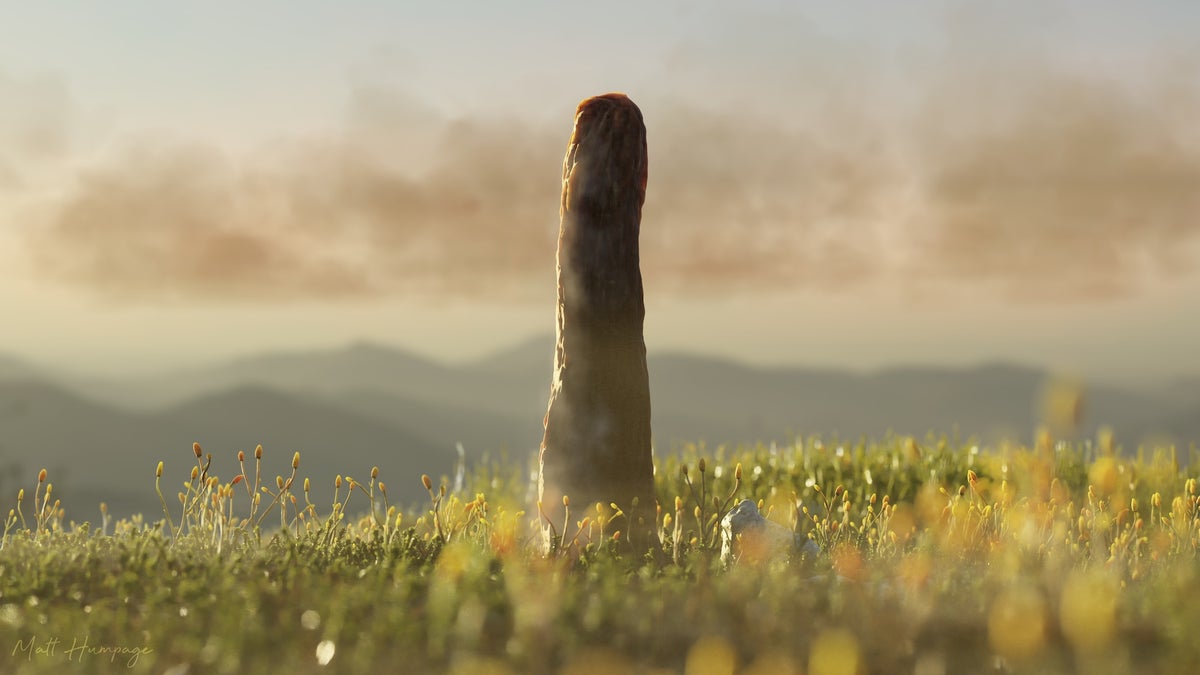
"Before trees came along some 400 million years ago, our planet's landscape was dominated by enigmatic, spire-shaped life-forms that towered more than 25 feet above the ground. Their trunklike fossils were discovered in 1843. Yet despite more than a century of speculation, scientists have struggled to answer the most basic question about Earth's original terrestrial giants: What were they? According to a new study, that may be because they belonged to a previously unknown branch of life."
"The first person to examine this biological misfit did so in 1855, and in 1859 he dubbed it Prototaxites, which means early yew. The name stuck, even though experts soon realized the organism wasn't a tree at all. Maybe it was some kind of land-based kelp or a megalithic mushroom? It feels like it doesn't fit comfortably anywhere, says Matthew Nelsen, a senior research scientist at the Field Museum of Natural History, who was not involved in the new study."
"Over time, two main hypotheses emerged: either Prototaxites was an ancient fungus, or it fell into a category all its own. Now, after comparing fossils from these cryptic organisms with fossil fungi from the same rock deposit, the authors of the new study, published today in Science Advances, conclude that Prototaxites was likely a distinct lineage. That would place it on an equal footing with the six currently recognized kingdoms of life: those of plants, animals, fungi, protists, bacteria and archaea."
Before trees appeared about 400 million years ago, spire-shaped organisms more than 25 feet tall dominated terrestrial landscapes. Fossils of their trunklike structures were found in 1843, and the form was named Prototaxites in 1859, although it proved not to be a tree. Interpretations have included giant fungi, land kelp, or a unique organism. Comparative analysis of Prototaxites fossils and contemporaneous fossil fungi reveals distinctive internal anatomy of interwoven tubes and spotted structure, supporting classification as a distinct lineage. Recognition as a previously unknown branch would place Prototaxites alongside the major kingdoms of life.
Read at www.scientificamerican.com
Unable to calculate read time
Collection
[
|
...
]