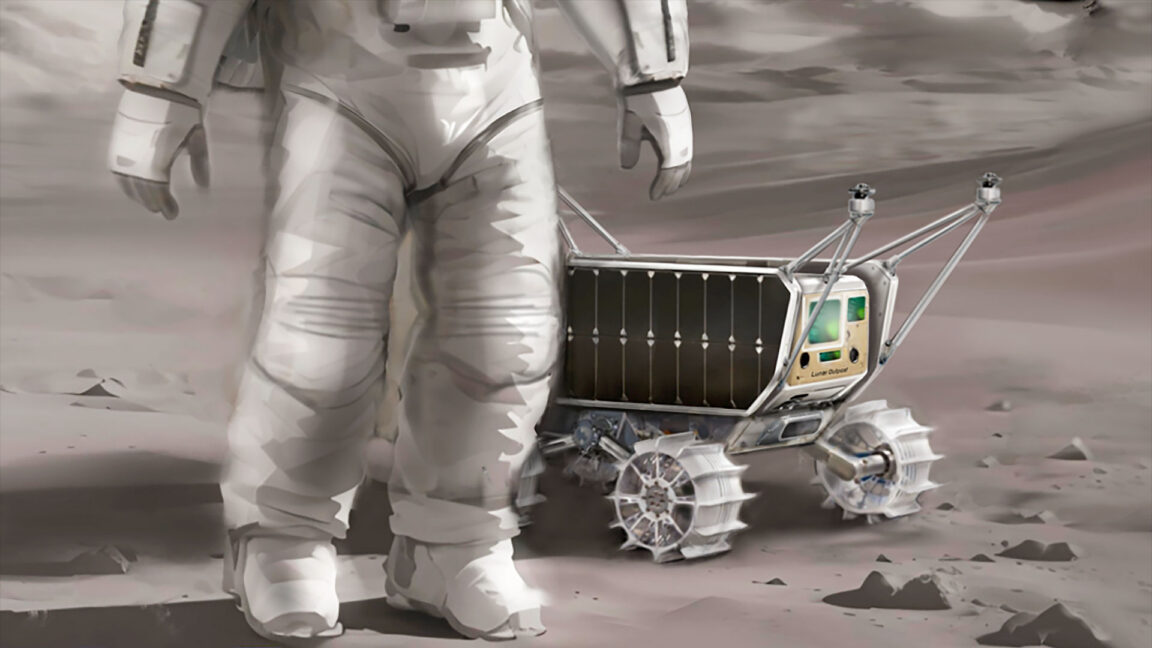
"Artemis IV will mark the second lunar landing of the Artemis program and build upon what is learned at the moon's south pole on Artemis III. "After his voyage to the Moon's surface during Apollo 17, astronaut Gene Cernan acknowledged the challenge that lunar dust presents to long-term lunar exploration. Moon dust sticks to everything it touches and is very abrasive," read NASA's announcement of the Artemis IV science payloads."
"To that end, the solar-powered MAPP will support DUSTER (DUst and plaSma environmenT survEyoR), a two-part investigation from the Laboratory for Atmospheric and Space Physics (LASP) at the University of Colorado, Boulder. The autonomous rover's equipment will include the Electrostatic Dust Analyzer (EDA), which will measure the charge, velocity, size, and flux of dust particles lofted from the lunar surface, and the RElaxation SOunder and differentiaL VoltagE (RESOLVE) instrument, which will characterize the average electron density above the lunar surface using plasma sounding."
"The University of Central Florida and University of California, Berkeley, have joined with LASP to interpret measurements taken by DUSTER. The former will look at the dust ejecta generated during the Human Landing System (HLS, or lunar lander) liftoff from the Moon, while the latter will analyze upstream plasma conditions. Lunar dust attaches to almost everything it comes into contact with, posing a risk to equipment and spacesuits."
Artemis IV will perform the Artemis program's second lunar landing and expand knowledge from the lunar south pole. A solar-powered MAPP rover will carry DUSTER, a two-part LASP investigation featuring the Electrostatic Dust Analyzer (EDA) and the RESOLVE plasma sounder. EDA will measure charge, velocity, size, and flux of dust particles lofted from the surface while RESOLVE will characterize average electron density above the surface using plasma sounding. University of Central Florida will study dust ejecta from Human Landing System liftoff and University of California, Berkeley will analyze upstream plasma. Lunar dust adheres to equipment, abrades surfaces, degrades solar arrays, and threatens astronaut health, motivating time- and location-resolved measurements for crew and system protection.
Read at Ars Technica
Unable to calculate read time
Collection
[
|
...
]