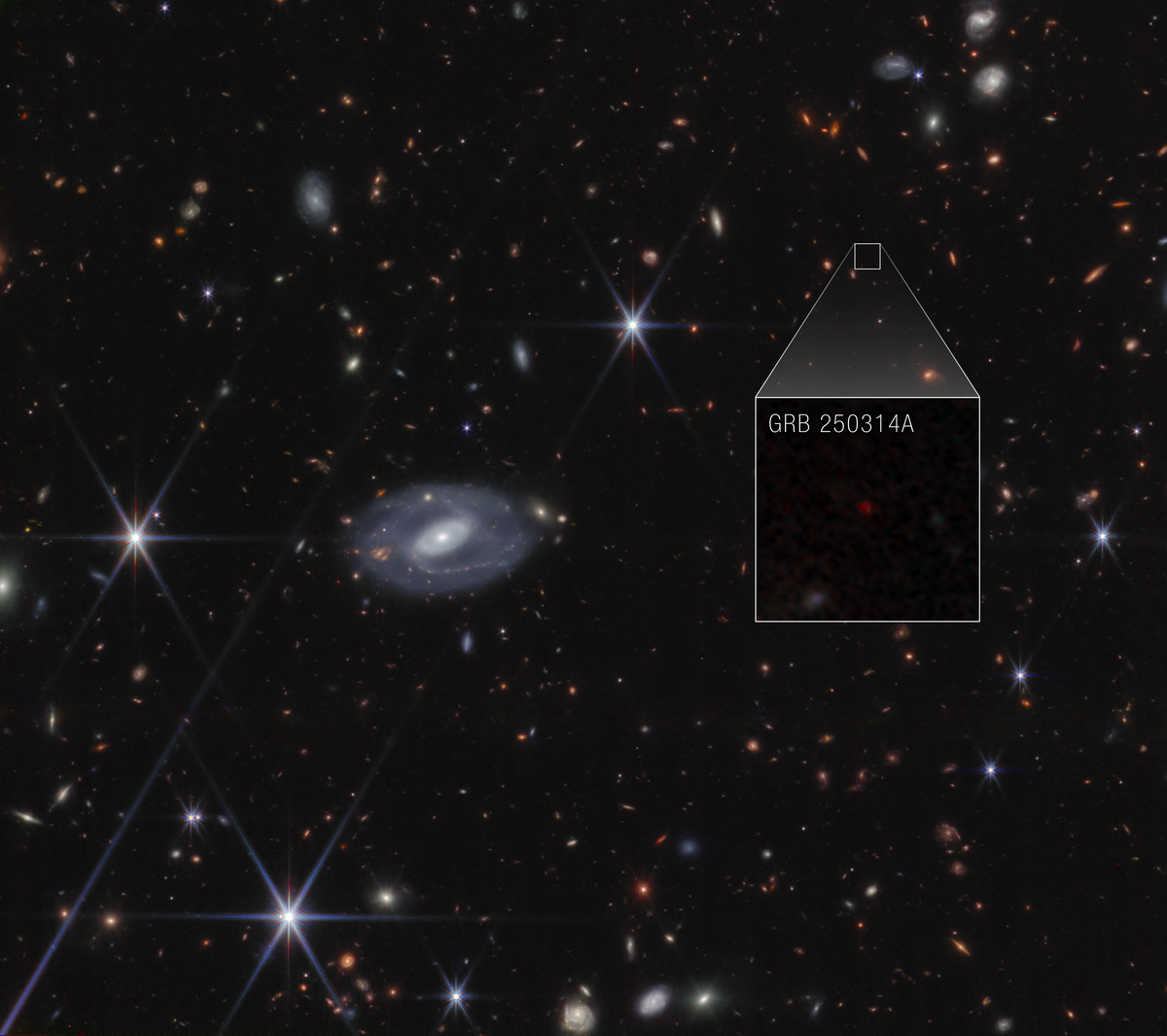
"Astronomers were surprised to find that this primeval explosion strongly resembles today's supernovae, which occur when massive stars run out of fuel for the nuclear fusion reactions that power them and then collapse under their own gravity. Scientists had suspected that the universe's earliest supernovae might look different because they represent the deaths of some of the first stars. Compared with today's stars, they formed in a smaller, denser cosmos and contained lighter elementsmainly hydrogen, helium and trace amounts of lithium."
"The James Webb Space Telescope has observed the oldest known supernovathe explosive death of a star that lived when the universe was only 730 million years old. The ancient blast occurred when the cosmos was just 5 percent of its current age, and the supernova's light has been traveling through space ever since."
"Astronomers first spotted this primordial supernova in March, thanks to a 10-second-long flash of high-energy light known as a gamma-ray burst. Such a burst can be caused by a collision between a black hole and a dense object called a neutron star oras in this caseby the death of a large star."
The James Webb Space Telescope identified a supernova that exploded when the universe was about 730 million years old, roughly 5 percent of its current age. The supernova's light has traveled across space since that ancient blast. The explosion closely resembles modern core-collapse supernovae, overturning expectations that earliest stellar deaths would appear substantially different. Early stars formed in a denser, smaller cosmos, were more massive, and contained primarily hydrogen, helium and trace lithium. The primordial event was detected as a 10-second gamma-ray burst, a signal that can arise from stellar collapse or compact-object collisions, offering insight into early stellar evolution and chemical enrichment.
Read at www.scientificamerican.com
Unable to calculate read time
Collection
[
|
...
]