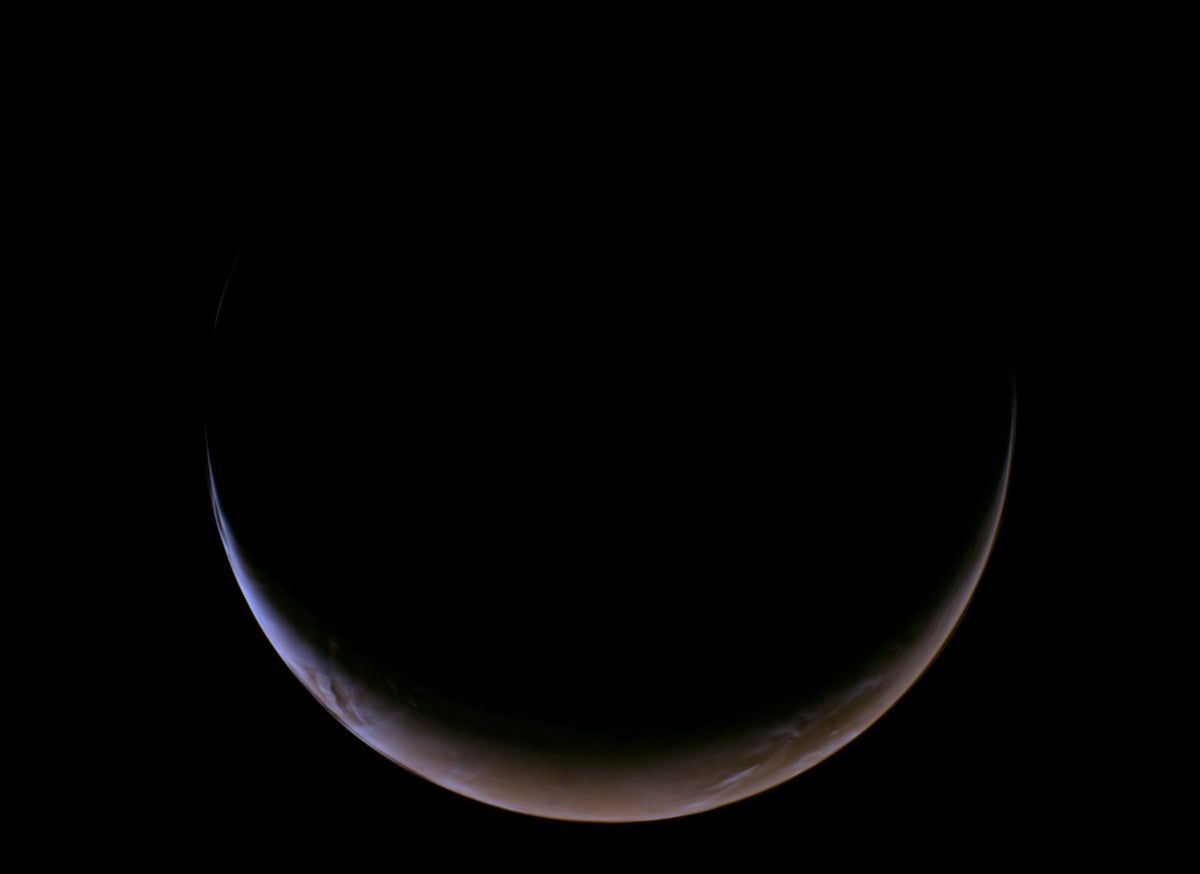
NASA’s Psyche mission performed a Mars flyby, coming within 2,864 miles of the planet’s surface. The spacecraft used Mars’s gravity to increase speed and adjust its trajectory toward the metal-rich asteroid 16 Psyche between Mars and Jupiter. New images include a high-resolution view of Mars’s south pole, where a 430-mile-wide ice cap is located. The mission began a six-year, 2.2-billion-mile journey on October 13, 2023. After reaching the asteroid in July 2029, Psyche will orbit it, photograph and map its surface, and use instruments including a magnetometer, gamma-ray and neutron spectrometer, and multispectral imager to determine chemical composition. The flyby also tested onboard cameras and NASA’s Deep Space Network Doppler system for tracking and communication.
"NASA's Psyche mission to study an asteroid beyond Mars played tourist last week, with the spacecraft flying by the Red Planet and snapping photographs as it went. Coming within 2,864 miles of the planet's surface at its closest approach, Psyche used the planet's gravity to boost its speed and adjust its course toward its ultimate destination: a metal-rich asteroid called 16 Psyche, which lies between Mars and Jupiter."
"Among the new photographs are a high-resolution snap of Mars's south pole, which is home to a 430-mile-wide ice cap. The Psyche mission began its six-year-long, 2.2-billion-mile trek into the solar system on October 13, 2023. After the probe reaches the asteroid in July 2029, Psyche will begin orbiting the object while snapping photographs and mapping the surface."
"Additionally, using its onboard science instrumentsa magnetometer, a gamma-ray and neutron spectrometer and a multispectral imagerthe spacecraft will try to determine 16 Psyche's chemical composition. The Mars flyby allowed the Psyche team not only to test out the spacecraft's cameras but also to try out NASA's Deep Space Network Doppler system, which uses the effects of relative motion on radio signals to better track and communicate with spacecraft in deep space."
Read at www.scientificamerican.com
Unable to calculate read time
Collection
[
|
...
]