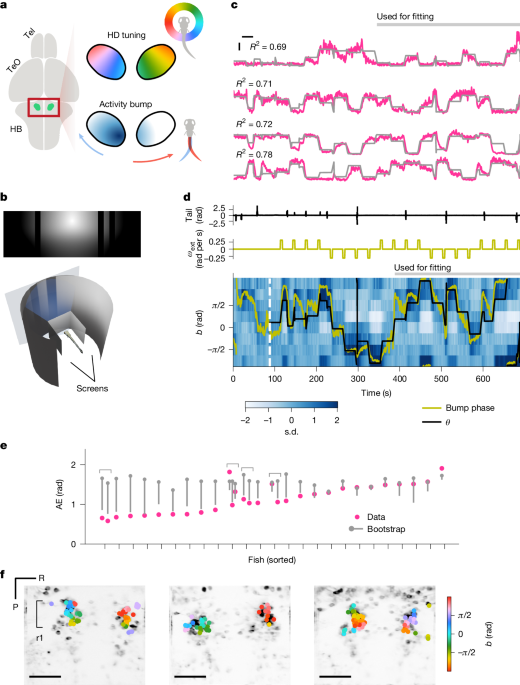
"A simple example of space-tuned cells is HD cells, which persistently fire when animals are facing a particular direction8. Because the head direction of an animal is typically not directly provided to the sensory system, HD cells need to integrate the history of rotational movements that animals make, a process called angular path integration. As a simple, yet biophysically plausible mechanism to implement angular path integration, a class of dynamical models called ring attractors has been proposed9."
"A ring attractor typically consists of neurons arranged on a topological ring, which excite nearby neurons while inhibiting far away neurons. Such connectivity architecture gives rise to a single, persistent bump of activity on the ring in the absence of external inputs, which can be used to represent the head direction. More than three decades of research have identified HD cells in various mammalian brain regions10. Yet, it has remained inconclusive where and how the tuning to head directions first emerges."
Head-direction (HD) cells persistently fire for specific facing directions and require integration of rotational movements because head direction is not directly sensed. Ring attractor networks, with neurons arranged on a topological ring that excite nearby and inhibit distant neurons, can generate a single persistent activity bump to represent head direction. Larval zebrafish have GABAergic HD cells in anterior hindbrain rhombomere 1 likely homologous to the mammalian dorsal tegmental nucleus. Those HD cell dendrites and axons form topographically organized columns in the dorsal interpeduncular nucleus producing mutual inhibition between oppositely tuned cells. Visual cues such as landmarks and optic flow can supplement motor-based integration.
Read at Nature
Unable to calculate read time
Collection
[
|
...
]