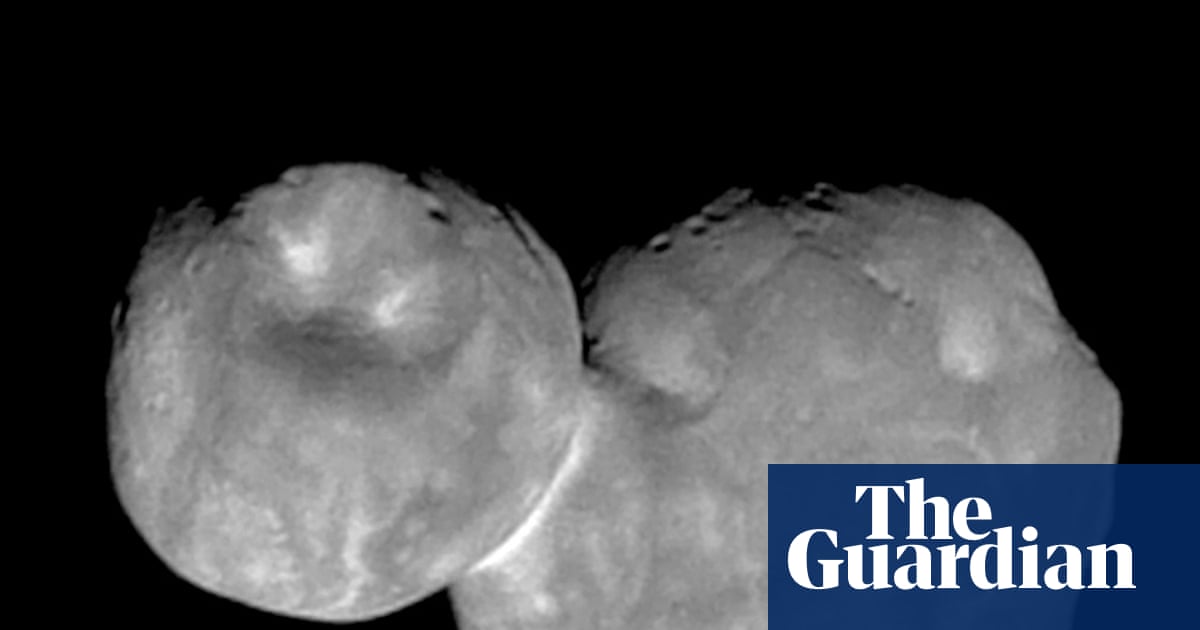
"It is the most distant and primitive object ever visited by a spacecraft from Earth: now researchers say they have fresh insights into how the ultra-red, 4bn-year-old body known as Arrokoth came to have its distinctive snowman-like shape. Arrokoth sits in the Kuiper belt, a vast, thick ring of icy objects that lies beyond the orbit of Neptune. This region of space is home to most of the known dwarf planets as well as comets and small, solid rubble heaps called planetesimals"
"Experts have previously said Arrokoth's shape, composition and small number of craters suggests both lobes formed at the same time and in a non-violent way, proposing that this could have occurred through a process known as gravitational collapse. However, the details of just how this would have happened have been debated. Now researchers have used computer simulations to show that gravitational collapse can indeed produce such double-lobed objects, and to shed light on the mechanism."
Arrokoth is an ultra-red, 4bn-year-old, bilobed planetesimal in the Kuiper belt, exhibiting a distinctive snowman-like shape and a scarcity of impact craters. The Kuiper belt contains icy dwarf planets, comets, and planetesimals that are remnants of the primordial protoplanetary disk. Vast rotating clouds of pebbles within that disk could undergo gravitational collapse, causing pebbles to clump into planetesimals of different sizes. Computer simulations demonstrate that gravitational collapse of pebble clouds can produce gently merged, double-lobed bodies without violent impacts. The simulations clarify collapse dynamics and support non-destructive formation pathways for a significant fraction of bilobed Kuiper belt objects.
Read at www.theguardian.com
Unable to calculate read time
Collection
[
|
...
]