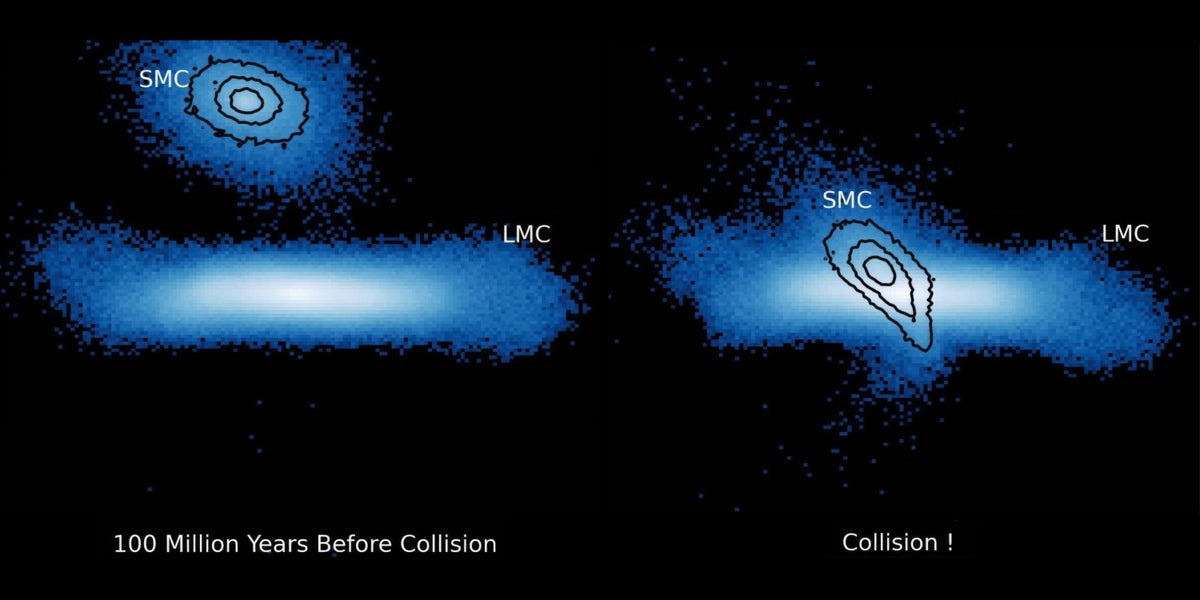
"Understanding of the inner structure and dynamical state of the Small Magellanic Cloud is a long-standing struggle in the field, says Michele De Leo, an astronomer at the University of Bologna. Any study to help explain this, he says, is a step in the direction of solving the puzzle of complex interactions between galaxies."
"For a galaxy with a given size and brightness, the rotation of both the stars and the disk of gas follow a reliable pattern. The Small Magellenic Cloud is a conspicuous exception. It's a small, elongated galaxy that people in the Southern Hemisphere can see regularly in the night sky—twenty degrees from its neighbor, the Large Magellenic Cloud."
"In the past few decades, astronomers have noticed that the stars in the smaller galaxy aren't swirling around its center as fast as they should, prompting researchers to investigate the cause of this anomalous rotation using computational simulations of the galaxies' hundred-million-year collision."
Astronomers have resolved a longstanding mystery about the Small Magellanic Cloud: its stars orbit slower than expected for a galaxy of its size and brightness. A new study published in the Astrophysical Journal used computer simulations to model a hundred-million-year collision between the Small Magellanic Cloud and its larger neighbor, the Large Magellanic Cloud. The simulations demonstrate that this ancient gravitational encounter disrupted the smaller galaxy's normal rotation patterns. Galaxies typically follow predictable rotation patterns based on their size and brightness, but the Small Magellanic Cloud has been a conspicuous exception. Understanding this interaction advances knowledge of complex galactic dynamics and helps explain the structural peculiarities observed in this dwarf galaxy visible from the Southern Hemisphere.
Read at www.scientificamerican.com
Unable to calculate read time
Collection
[
|
...
]