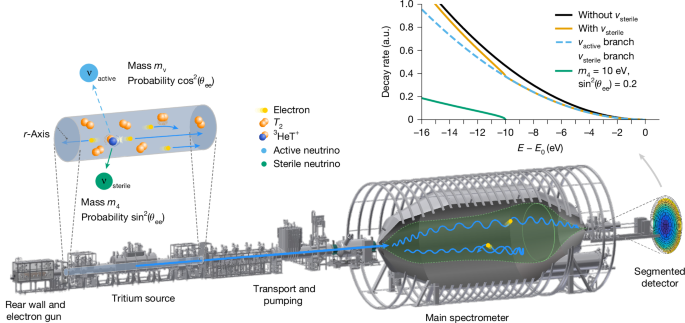
"A hypothetical fourth neutrino state (ν 4), with a well-defined mass m4, could exist as a natural extension of the Standard Model of particle physics4. This mass state would predominantly lack a marked flavour component, with small contributions from e, μ and τ flavours. This minimal flavour association is why it is often referred to as a 'sterile neutrino' (ν s). Active neutrinos can oscillate into sterile neutrinos, and mixing between these states acts as the fundamental mechanism for indirectly detecting sterile neutrinos."
"In the context of a 3 + 1 neutrino model1, the extended PMNS matrix U is a 4 × 4 unitary matrix that describes the mixing between flavour and mass eigenstates. The element | Ue4| 2, also labelled sin 2( θee), sets the oscillation amplitude3. For direct comparison with disappearance oscillation experiments, this is often recast as sin 2(2 θee) = 4sin 2( θee)(1 − sin 2( θee)). A sterile-neutrino signature typically manifests as deviations in the outgoing lepton flux or energy spectrum."
Three neutrino flavours (electron, muon, tau) interact only via the weak force and undergo flavour oscillation linking flavour eigenstates to mass eigenstates. A fourth mass state (ν4) with mass m4 could exist that largely lacks an active flavour component and is termed a sterile neutrino (νs). Active-to-sterile mixing provides the indirect detection mechanism. In a 3+1 model the PMNS matrix extends to 4×4 and the element |Ue4|^2 (sin^2(θee)) sets the oscillation amplitude, commonly expressed as sin^2(2θee)=4sin^2(θee)(1−sin^2(θee)). Sterile signatures appear as deviations in outgoing lepton flux or energy spectra. Experimental anomalies such as the gallium and reactor antineutrino deficits motivate searches for such states.
Read at Nature
Unable to calculate read time
Collection
[
|
...
]