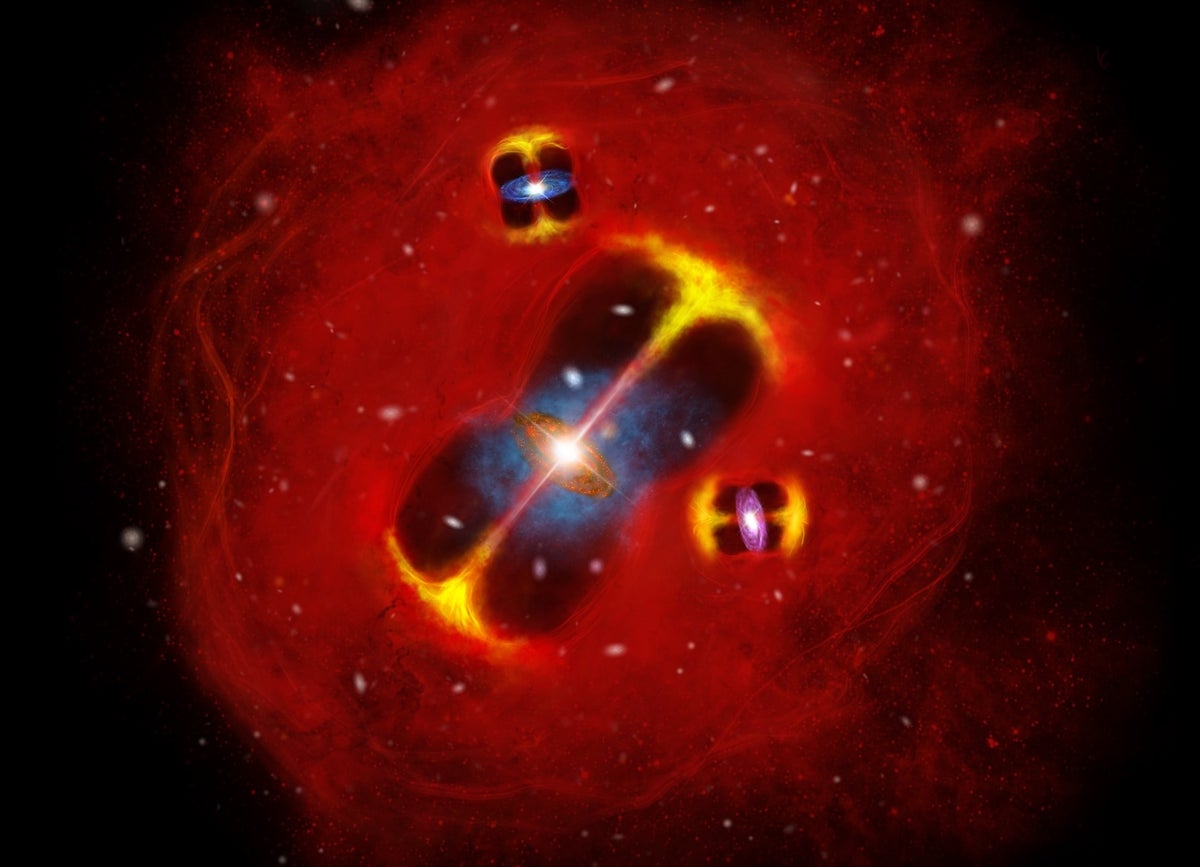
A galaxy cluster named SPT2349-56 existed when the universe was 1.4 billion years old. Gas threaded between roughly 30 active member galaxies reached temperatures at least five times higher than theoretical expectations for that epoch. The intracluster gas was hotter than the sun and hotter than typical present-day clusters. Observations came from ALMA, which allowed astronomers to probe that early epoch. Findings imply more early-universe objects produced vast amounts of energy than expected. The heating mechanism remains unknown and further research could clarify cluster formation and cosmic evolution.
"Using the Atacama Large Millimeter/submillimeter Array, or ALMA, Zhou and his team were able to peer back to the early universe. Zhou and his colleagues found that the gas that is threaded between the 30 or so active galaxies in this cluster, known as SPT2349-56, is much hotter and more plentiful than it should be. The gas is far hotter than the sun, Zhou told New Scientist, and far hotter than what many astronomers find in present-day clusters."
"Their findings suggest that there were more objects like SPT2349-56 producing vast amounts of energy during a moment in the universe's early history in which scientists had thought such objects simply didn't do so. The team doesn't know why the gas is so hot, but future research to find out could help astronomers better understand how the universe as we know it evolved."
Read at www.scientificamerican.com
Unable to calculate read time
Collection
[
|
...
]