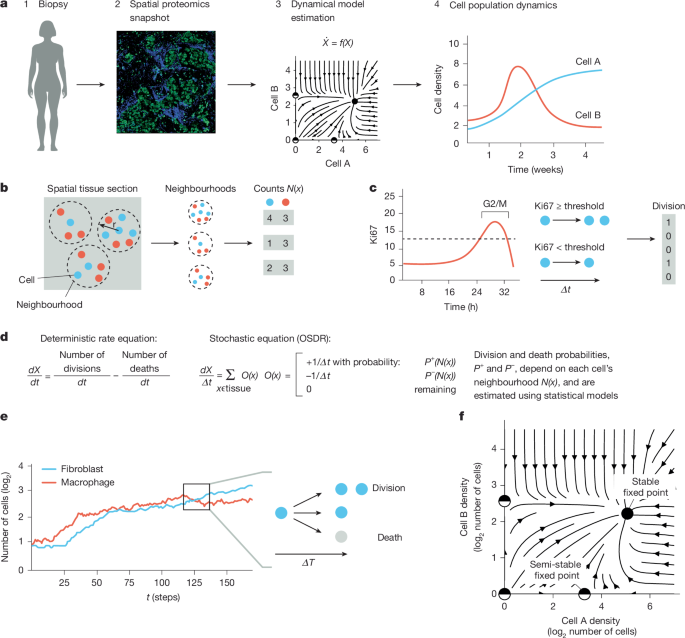
"Some cell populations expand and others are removed, as occurs in development and in the immune response to pathogens9. A clinically important example of changing cell populations is the evolution of the cancer microenvironment, in which the growing tumour recruits stromal and immune cells that are crucial for tumour survival10,11. Understanding cell population dynamics and the underlying cell-cell communication circuits is a major goal of tissue biology, and can enable new treatment strategies based on sculpting cell populations in desired ways7,12."
"However, measuring the dynamics of cell populations in human tissues is currently very difficult. Biopsies provide a single snapshot, and taking multiple biopsies from a single patient is infeasible and does not provide longitudinal evidence from the same cells. Current strategies to measure tissue dynamics do not apply to human biopsies. For example, cell lines, mice, organ-on-a-chip13 or organoid models14 are treated as replicas and are analysed at different time points. Ex vivo tissues can be followed over time but lack the native physiological context."
Physiological processes involve cell populations that change over time, with some populations expanding and others being removed during development and immune responses. The cancer microenvironment exemplifies evolving populations as tumours recruit stromal and immune cells that support tumour survival. Measuring these dynamics in human tissues is difficult because biopsies give single snapshots and repeat sampling of the same cells is infeasible. Common experimental strategies using cell lines, animal models, organ-on-a-chip or organoid models, and ex vivo tissues fail to capture native human in vivo context. Emerging single-cell technologies and computational methods such as RNA velocity, ergodic rate analysis and Zman-seq offer opportunities to infer temporal cellular processes.
Read at Nature
Unable to calculate read time
Collection
[
|
...
]