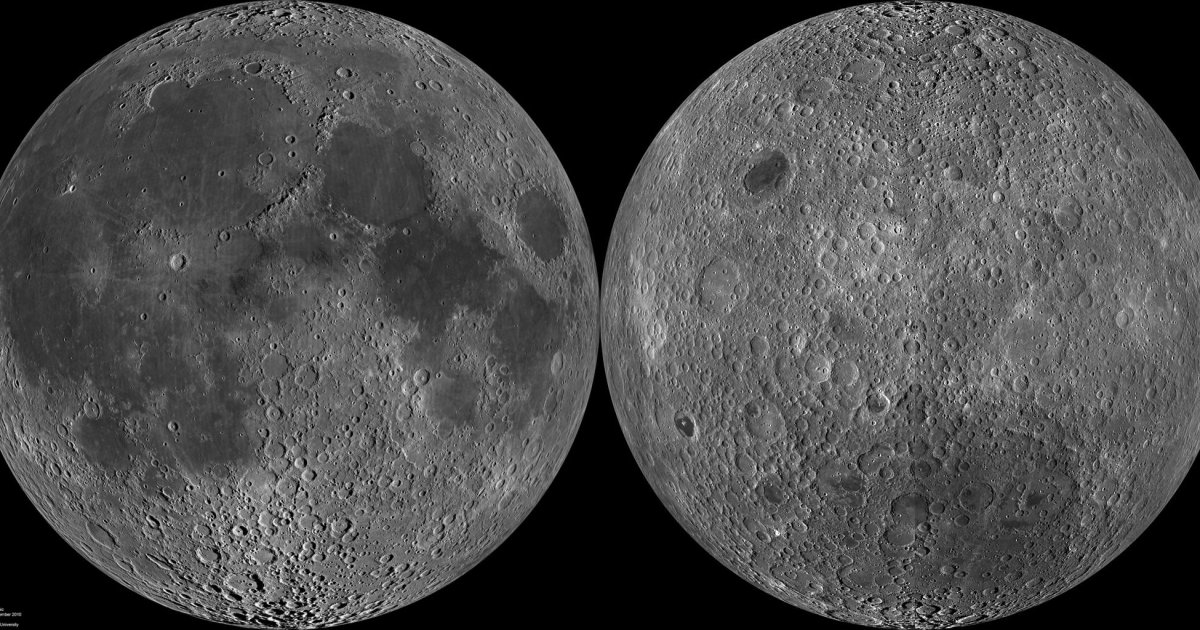
"The Moon, by far, is the brightest object and largest object that's visible to human eyes in Earth's night sky. Compared to Venus, the next brightest object that appears, the Moon is thirty times the diameter, takes up almost 1000 times the surface area, and appears about 1,000,000 times brighter than Venus. Moreover, the Moon doesn't appear as a uniform disk to us, but rather shows incredible differences from place-to-place across the surface, even as viewed from our limited perspective here on Earth."
"To the naked eye, these differences might just appear as bright-and-dark patches: the so-called "man in the Moon" is the easiest feature to see. But if you take a look through a telescope, you won't just see those dark spots silhouetted against the brighter portions, but also mountain ridges, craters with high walls and rays splaying out from them, and shadowy relief along the night-day boundary, known as the Moon's terminator."
The Moon is the brightest and largest object visible in Earth's night sky, vastly outshining Venus in size and brightness. The lunar surface is nonuniform, showing bright and dark regions that reveal topography and composition differences. Naked-eye views show bright-and-dark patches like the "man in the Moon," while telescopic views reveal mountain ridges, crater walls, ejecta rays, and terminator shadows. Heavily cratered highlands contrast with darker maria that have fewer and smaller craters. Nested craters indicate sequential impacts over time, with larger craters being significantly older than many smaller, overprinted ones.
Read at Big Think
Unable to calculate read time
Collection
[
|
...
]