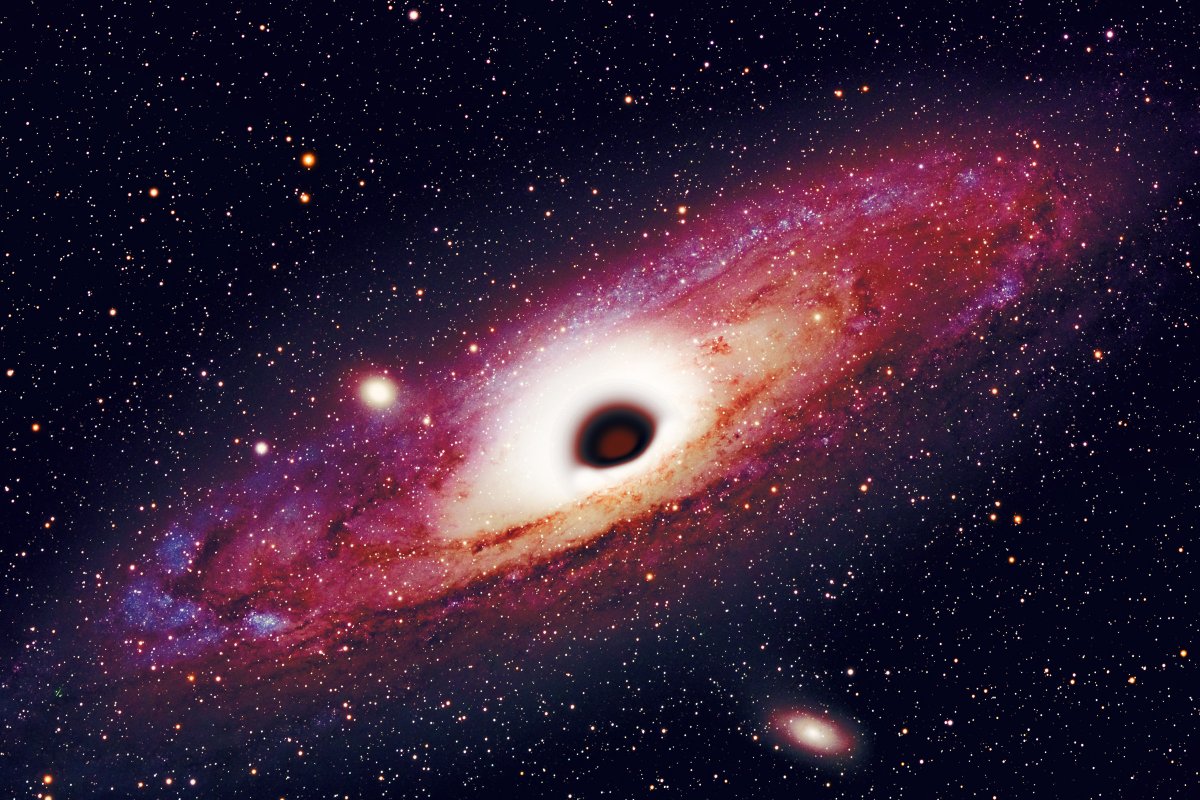
"The traditional understanding is that the center of our galaxy is dominated by a supermassive black hole. The "supermassive" part isn't a mere superlative; your typical black hole that forms from the explosive death of a star weighs up to dozens of times than the Sun, while a supermassive one like the Milky Way's Sagittarius A* would be around four million times our star's mass."
"Instead of a black hole, there could be something else lurking there that's also invisible to observers: a colossal clump of dark matter, the substance thought to account for 85 percent of all mass in the cosmos. A new study, published in the journal Monthly Notices of the Royal Astronomical Society, argue s this would be possible if the dark matter entity was made of subatomic particles called fermions."
"In their study, the team found that replacing Sgr A* with a fermionic clump reproduced the black hole's immediate gravitational effects, including the orbits of fast-moving stars near the galactic center that zip around at speeds up to a few thousands kilometers per second called S-stars. Additionally, the dark matter theory could explain another galactic phenomenon: why stars at the outskirts of the Milky Way appear to drop off in speed, called Keplerian decline."
Fermionic dark matter could form a dense, compact core at the Milky Way center that mimics a supermassive black hole's gravitational influence. Typical stellar black holes weigh up to dozens of solar masses, while the Milky Way's central object measures about four million solar masses. Dark matter is inferred to make up about 85 percent of cosmic mass and usually forms diffuse halos. Fermionic particles obey the Pauli exclusion principle, producing pressure that allows dark matter to compress into a tightly packed core. Such a fermionic core can reproduce S-stars' high-speed orbits and may explain the Keplerian decline of outer-star velocities.
Read at Futurism
Unable to calculate read time
Collection
[
|
...
]