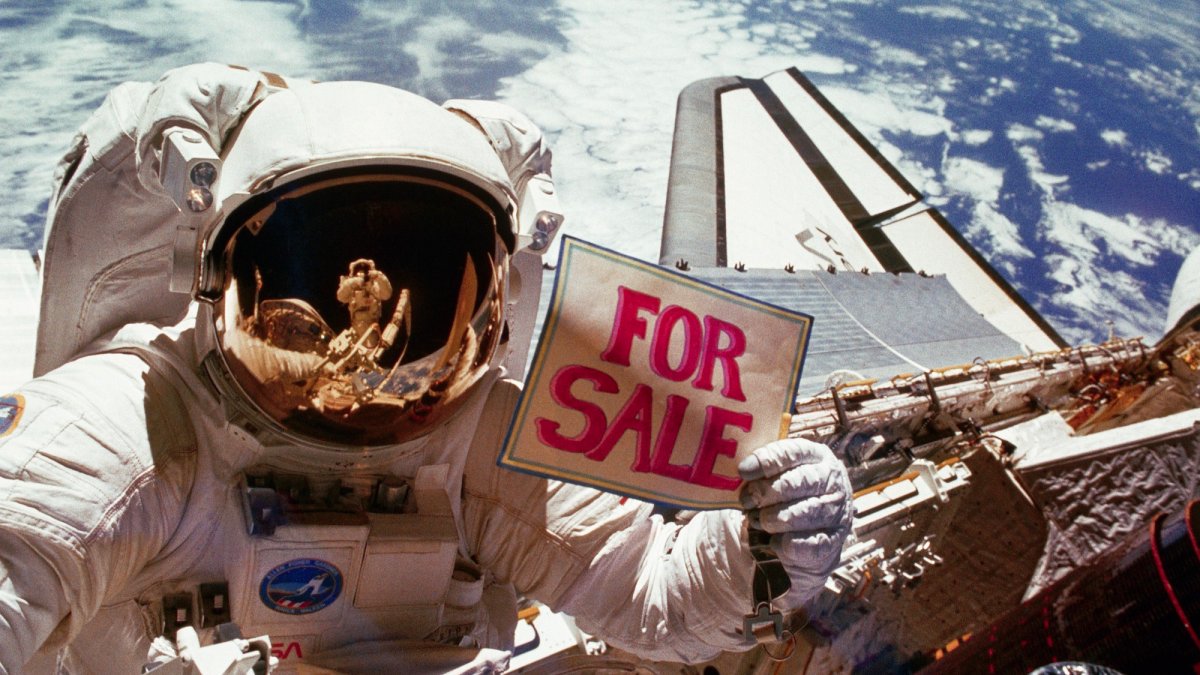
"In 1993, Mike Lawson, an aerospace entrepreneur based in Roswell, Georgia, unveiled his vision for a brave new future of advertising: space billboards. This wasn't a half-baked scheme: Lawson had meticulous plans for a proposed 1996 launch: His team of engineers would shoot a package of tightly-wound mylar into orbit about 180 miles above the Earth. Once there, the material would unfurl into a thin, reflective sheet up to a mile long and a quarter mile tall,"
"The sheet would catch the sun's rays, amplified by a series of small mirrors attached to the platform, and reflect them into the atmosphere. This would create a roughly moon-sized image in the sky of whatever single design the team printed on the banner. It would probably just be a big company logo, Lawson admitted, as the visual would be a little too low-res to read any ad copy without the aid of a telescope."
In 1993 Mike Lawson proposed launching a mylar banner into low Earth orbit to serve as a space billboard. The plan called for a 1996 launch carrying tightly wound mylar that would unfurl about 180 miles above Earth into a reflective sheet up to a mile long and a quarter-mile tall, framed by inflatable mylar tubes. Small mirrors would amplify sunlight and reflect a moon-sized image of a single printed design into the sky. The image would be low-resolution, suitable for large logos, and visible to each location for roughly ten minutes daily. NASA judged the concept technically feasible. Earlier ideas and experiments had imagined or used corporate-visible elements in space.
Read at Popular Science
Unable to calculate read time
Collection
[
|
...
]