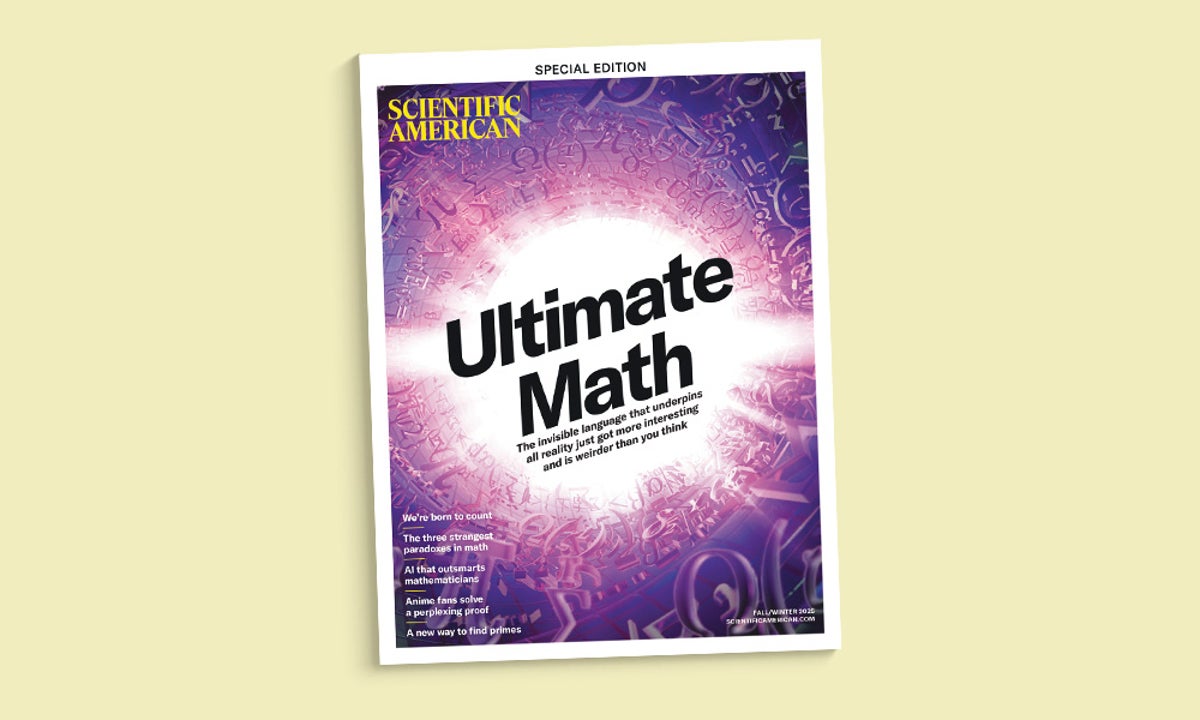
"In October 2024 Luke Durant, an independent researcher in San Jose, Calif., announced that he had discovered the largest known prime numberso enormous it would take years to write out in full. One might suspect only mathematicians would celebrate such a feat. But primes are often considered the building blocks of mathematics, and math itself is the scaffolding that supports everything from quantum theory and smartphone algorithms to the stability of bridges and even the odds at a casino."
"Humans are natural mathematicians, and trials have shown that babies are born with an inherent sense of numbers. For some this natural ability leads to a lifelong devotion: in 2023 precocious high school students published a proof of the Pythagorean theorem that uses trigonometry, and the winner of the 2025 Abel Prize in mathematics was Masaki Kashiwara, who has studied the field for nearly seven decades."
"The quest for larger primes continues, and researchers are devising new ways to seek them out, including a method that involves integer partitions. Many questions in math have long histories, such as the Langlands conjecture, which has stumped scientists for more than 50 years. The field is replete with paradoxes. For example, if you run the equation 1 1 + 1 1 + 1 1 + ... forever, the answer is not zero and not straightforward."
In October 2024 Luke Durant, an independent researcher in San Jose, Calif., announced discovery of the largest known prime, so enormous it would take years to write in full. Primes serve as building blocks of mathematics, which underlies quantum theory, smartphone algorithms and the stability of bridges. Humans show innate numeric intuition from infancy, and some pursue mathematics lifelong, evidenced by student proofs and Masaki Kashiwara's decades-long work recognized by the 2025 Abel Prize. Researchers seek larger primes using methods like integer partitions, while problems such as the Langlands conjecture remain unresolved. The field contains paradoxes that challenge understanding of infinity and probability.
Read at www.scientificamerican.com
Unable to calculate read time
Collection
[
|
...
]