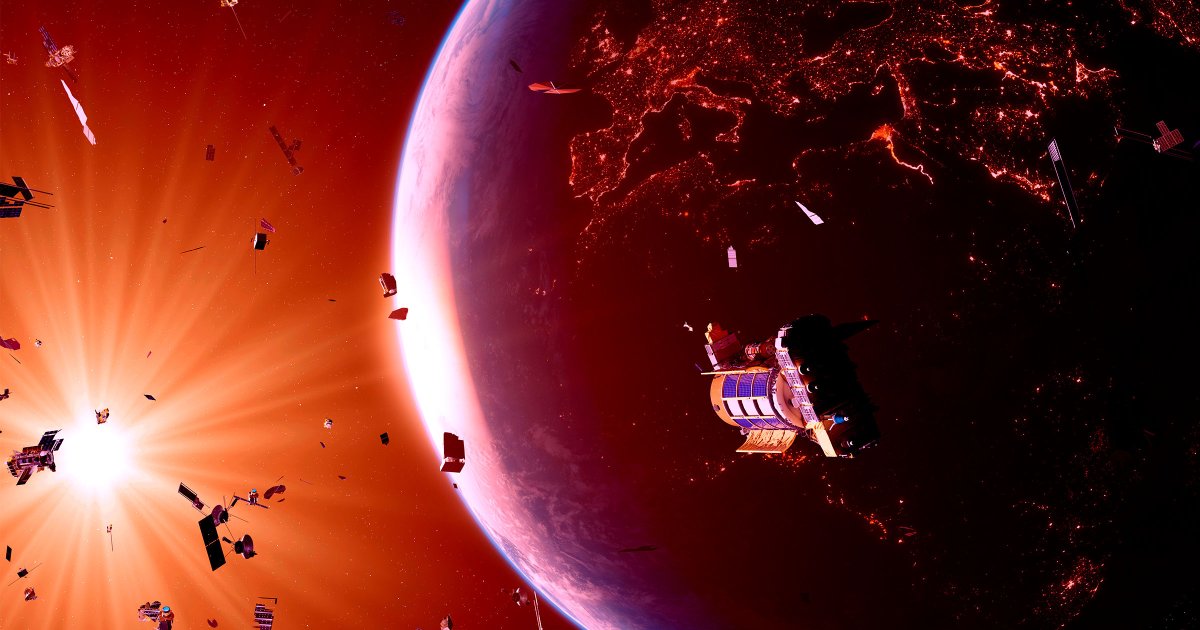
Donald Kessler warned that one satellite collision can escalate into follow-up accidents that increase collision probability and form a debris belt around Earth within this century. The resulting Kessler syndrome arises from thousands of human-made objects, discarded launch debris, and planned megaconstellations. Kessler syndrome endangers astronauts and could render orbital operations and future exploration extremely hazardous by creating a dense, damaging field of debris. A new metric called the Collision Realization and Significant Harm (CRASH) Clock aims to quantify the time to a catastrophic collision absent avoidance maneuvers, to measure orbital stress and motivate mitigation.
"In 1978, NASA researcher Donald Kessler and his colleagues published a paper titled "Collision frequency of artificial satellites: The creation of a debris belt." The paper laid down a grim warning: a single collision between satellites that would escalate into a series of followup accidents, "each of which would increase the probability of further collisions, leading to the growth of a belt of debris around the Earth." "Under certain conditions, the belt could begin to form within this century and could be a significant problem during the next century," the prescient paper warned."
"Such a catastrophic series of cascading events, has since been dubbed "Kessler syndrome." The term highlights the considerable risks of littering our planet's orbit with many thousands of human-made objects, including multiple megaconstellations of satellites, as well as all the junk that gets left behind after they're launched and decommissioned. Not only does it put astronauts at risk, but Kessler syndrome could also greatly complicate future space exploration efforts by turning the planet's orbit into a whirling vortex of death."
"Now, an international team of researchers from Princeton University, the University of British Columbia, and the University of Regina, has attempted to quantify this risk by coming up with a new metric, called the "Collision Realization and Significant Harm (CRASH) Clock." "There is substantial potential for current or planned actions in orbit to cause serious degradation of the orbital environment or lead to catastrophic outcomes, highlighting the urgent need to find better ways to quantify stress on the orbital environment," they wrote in a yet-to-be-peer-reviewed paper, first spotted by Gizmodo."
Read at Futurism
Unable to calculate read time
Collection
[
|
...
]