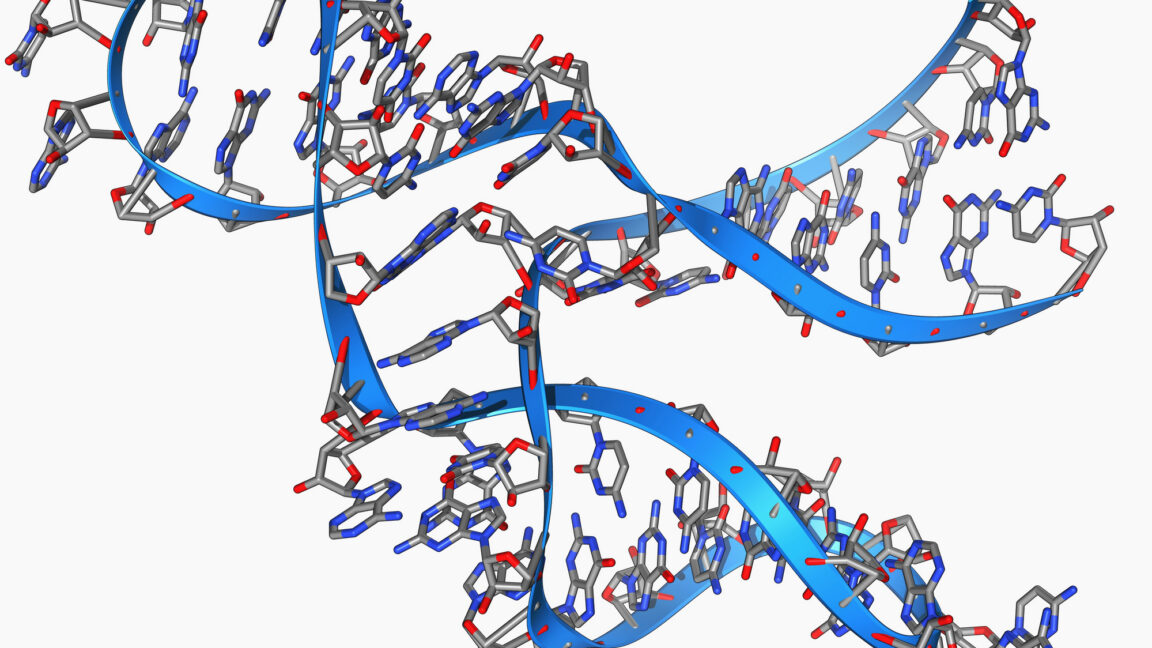
"There are plenty of unanswered questions about the origin of life on Earth. But the research community has largely reached consensus that one of the key steps was the emergence of an RNA molecule that could replicate itself. RNA, like its more famous relative DNA, can carry genetic information. But it can also fold up into three-dimensional structures that act as catalysts. These two features have led to the suggestion that early life was protein-free, with RNA handling both heredity and catalyzing a simple metabolism."
"For this to work, one of the reactions that the early RNAs would need to catalyze is the copying of RNA molecules, without which any sort of heritability would be impossible. While we've found a number of catalytic RNAs that can copy other molecules, none have been able to perform a key reaction: making a copy of themselves. Now, however, a team has found an incredibly short piece of RNA-just 45 bases long-that can make a copy of itself."
Consensus suggests that the emergence of an RNA molecule capable of self-replication was a critical step in the origin of life. RNA can both store genetic information and fold into catalytic three-dimensional structures, enabling heredity and metabolism without proteins. Early RNAs would need to catalyze RNA copying to enable heritability. Many catalytic RNAs (ribozymes) exist; some function as ligases linking RNA fragments, sometimes requiring a third RNA to align substrates. A smaller set of ribozymes act as polymerases, adding bases guided by a template, and some ligases have been evolved into polymerases. A 45-base RNA has been found that can copy itself.
Read at Ars Technica
Unable to calculate read time
Collection
[
|
...
]