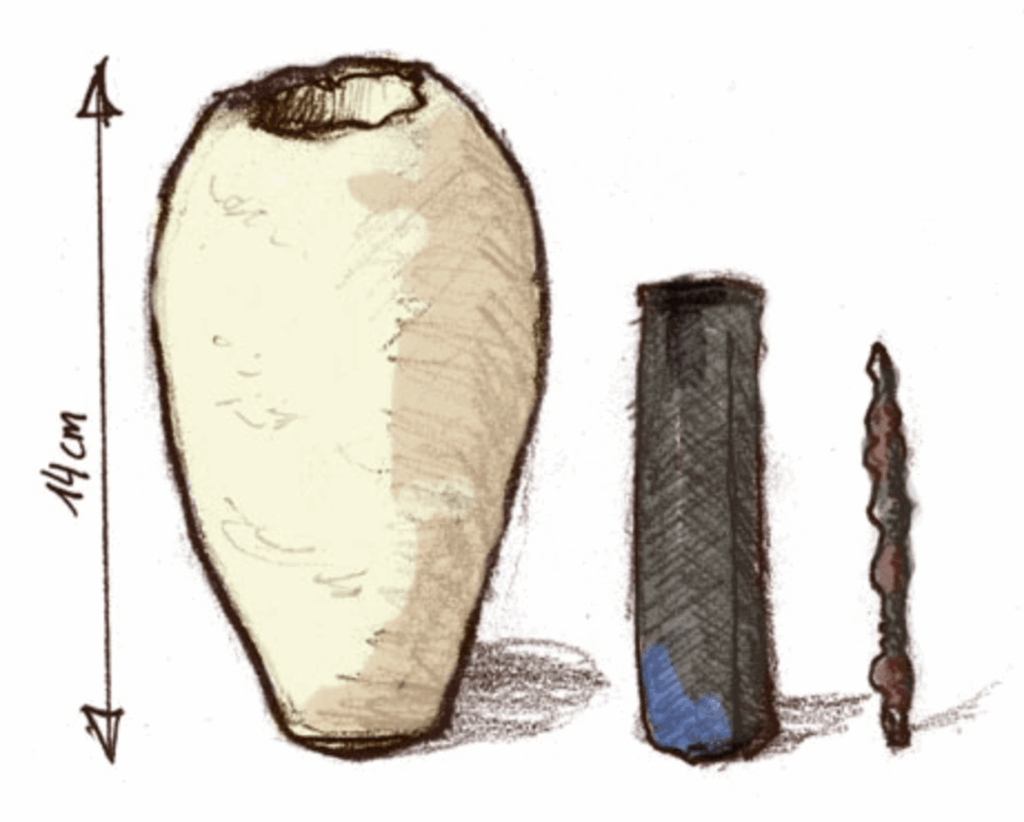
"The average Open Culture reader may well be aware that there is such a thing as Archaeology YouTube. What could come as more of a surprise is how much back-and-forth there is within that world. Below, we have a video from the channel Artifactually Speaking in which Brad Hafford, a University of Pennsylvania archaeologist, gives his take on the so-called Baghdad Battery, an ancient artifact discovered in modern-day Iraq. He does so in the form of a response to an earlier video on the Baghdad Battery from another channel hosted by a young archaeology educator called Milo Rossi. At some points Hafford agrees, and at others he has corrections to make, but surely both YouTubers can agree on the fascination of the object in question. After all: an ancient battery?"
"Even those of us without any particular investment in archaeology may find our curiosity piqued by the notion that some long-vanished civilization had managed to harness electricity. The name Baghdad Battery was granted in the first place by Wilhelm König, who was the director of the laboratory of the National Museum of Iraq in the nineteen-thirties, when the object was originally discovered."
Archaeology YouTube features active back-and-forth engagement about enigmatic objects. The Baghdad Battery, found in modern-day Iraq in the 1930s, consists of a ceramic pot, a copper tube, and an iron rod sealed with bitumen. The combination made an electrical or power-storage function a plausible interpretation for some observers. Bitumen, a substance present in crude oil and used in asphalt, figures into reconstructions of its sealing and possible operation. Archaeologists and educators analyze the object, agree on some points, and make corrections on others, while shared fascination centers on whether ancient peoples might have harnessed electricity.
Read at Open Culture
Unable to calculate read time
Collection
[
|
...
]