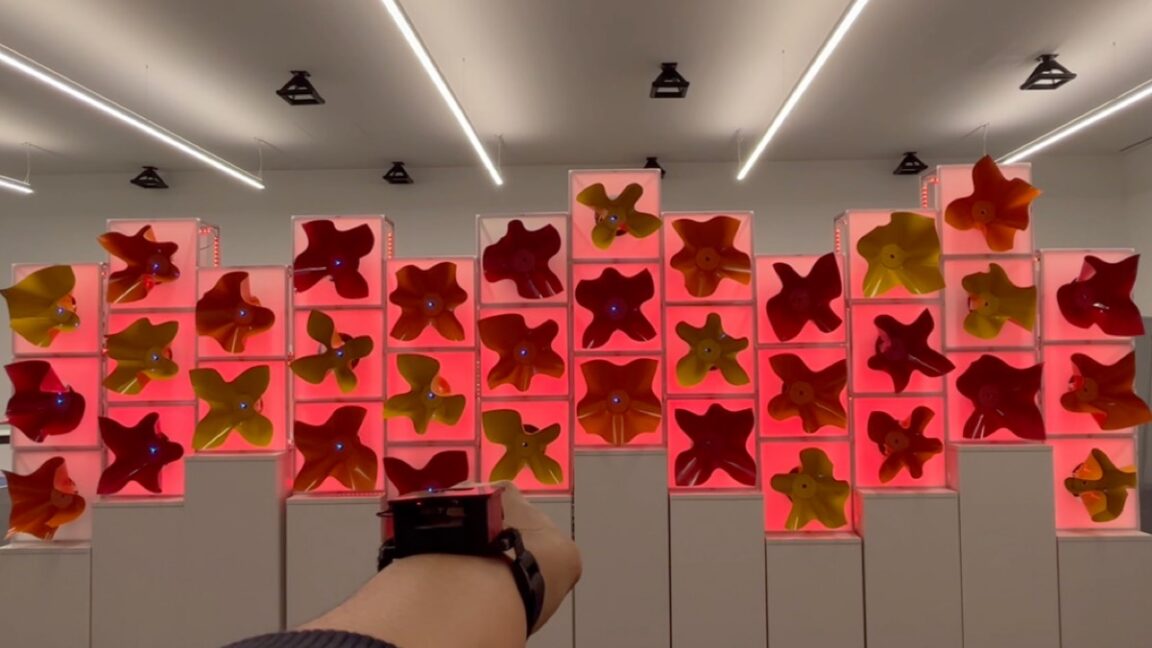
A swarm of interconnected mini-robots blooms in response to changing light levels, demonstrating a light-responsive collective morphology. Such robotic swarms can act as dynamic facades in architectural designs, enabling buildings to adapt to shifting climate conditions and to interact with occupants in creative ways. Biomimetic inspiration comes from living architectures like beehives and from fire ant collectives that transition between individual and collective behaviors, exhibiting solid and liquid properties and effective traffic regulation. Prior swarm robotics work includes ant-like robots that dig through simulated soil and studies of jackdaw flocks that adapt interaction rules for different tasks, informing adaptable swarm control.
"Researchers at Princeton University have built a swarm of interconnected mini-robots that "bloom" like flowers in response to changing light levels in an office. According to their new paper published in the journal Science Robotics, such robotic swarms could one day be used as dynamic facades in architectural designs, enabling buildings to adapt to changing climate conditions as well as interact with humans in creative ways."
"A few ants spaced well apart behave like individual ants. But pack enough of them closely together, and they behave more like a single unit, exhibiting both solid and liquid properties. You can pour them from a teapot like ants, as Goldman's lab demonstrated several years ago, or they can link together to build towers or floating rafts-a handy survival skill when, say, a hurricane floods Houston. They also excel at regulating their own traffic flow. You almost never see an ant traffic jam."
Read at Ars Technica
Unable to calculate read time
Collection
[
|
...
]