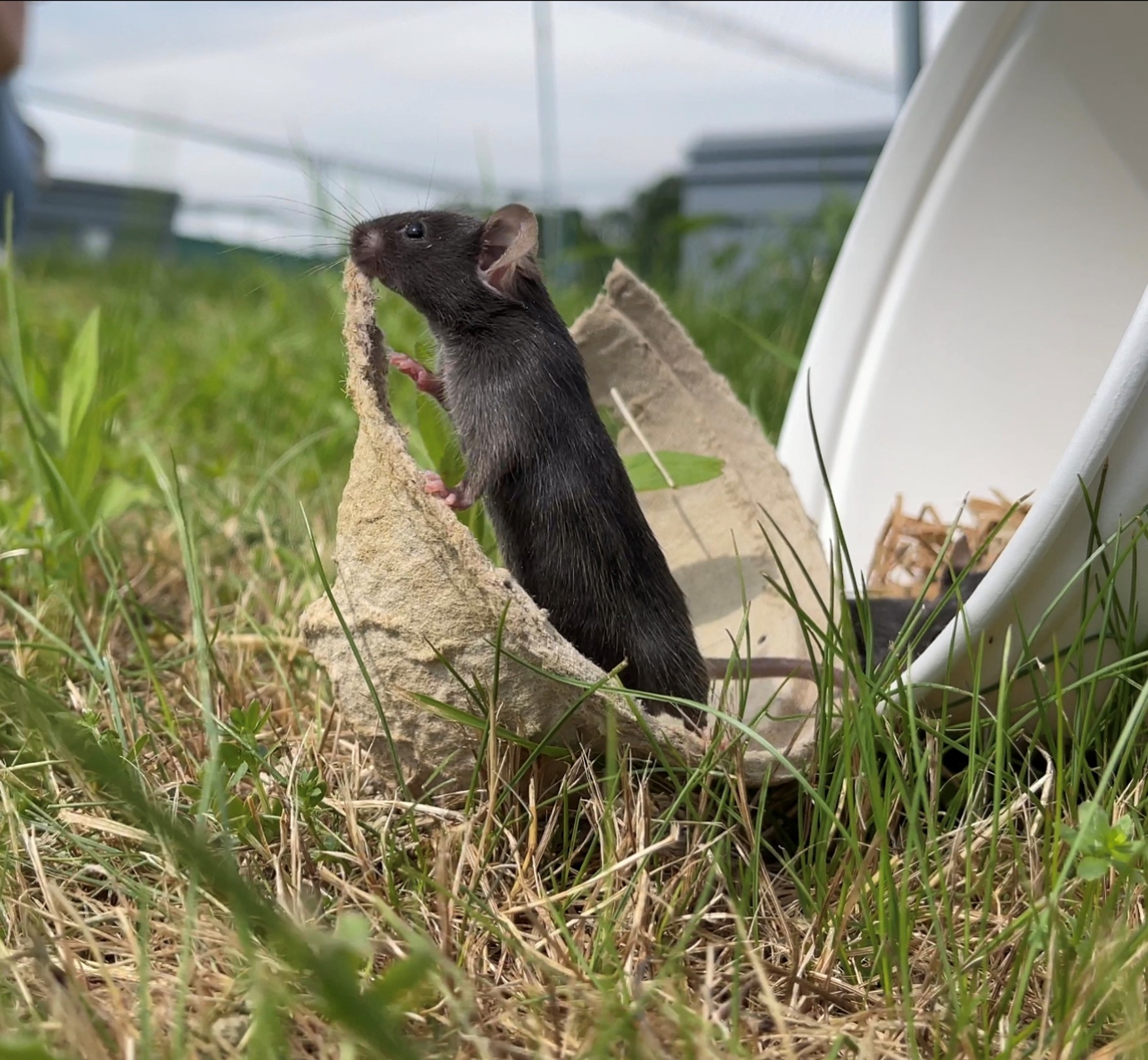
"Each time Matthew Zipple, a behavioral ecologist at Cornell University, releases a mouse that was born and raised in a laboratory into the green expanse of a field, he is amazed. He transports the mouse in a paper cup, lays the cup on its side in the grass, and takes off the lid. "When the lids come off it's like they are on another world, from their perspective," he wrote in an email. "There are a million new smells, there's grass, there's dirt, there is sunshine.""
"The mouse's new world is an enclosed field approximately 10,000 times the size of their shoebox-sized cage. The field is full of other former laboratory mice, each of whom lived the same shoebox life before the field. Within a few days, the mouse has explored the entire enclosure. In the field, the mice build nests, dig burrows, and find their own food."
Lab mice released into a large enclosed field approximately 10,000 times the volume of their cages rapidly explored the space and engaged in natural behaviors. The mice built nests, dug burrows, foraged for food, selected social partners, and experienced weather for the first time. These environmental and social changes produced an utter transformation of learned fear and anxiety responses. Standardized laboratory conditions contrast sharply with the complexity of the field environment. The behavioral shifts imply that environmental complexity profoundly shapes fear and anxiety, with implications for interpreting laboratory-based findings and for potential approaches to reduce anxiety in other animals and humans.
Read at Defector
Unable to calculate read time
Collection
[
|
...
]