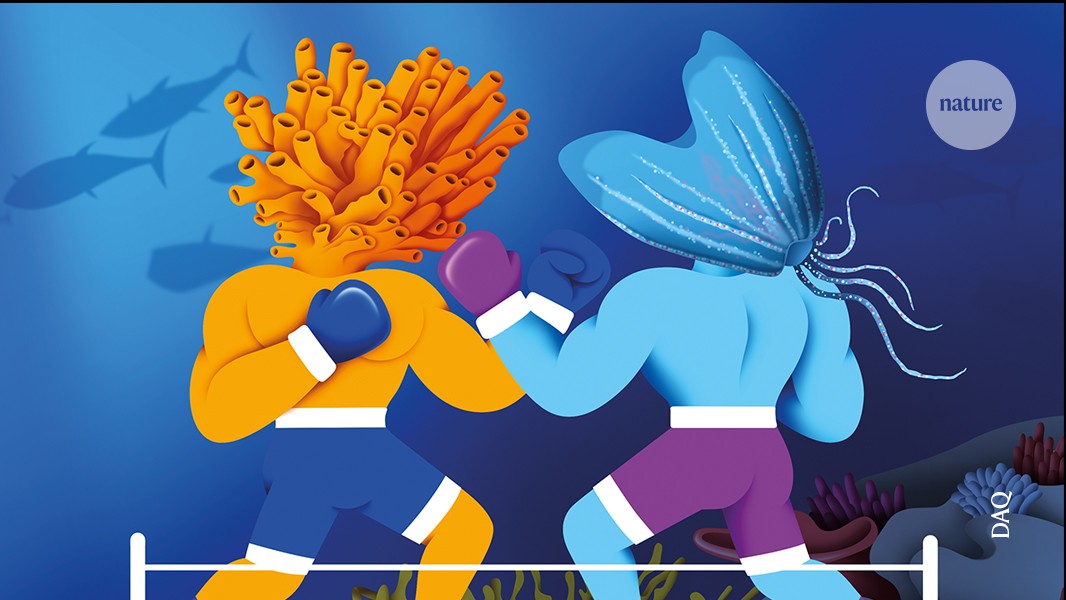
"Which animals came first? For more than a century, most evidence suggested that sponges, immobile filter-feeders that lack muscles, neurons and other specialized tissues, were the first animal lineages to emerge. Then, in 2008, a genomic study pointed to a head-scratching rival: dazzling, translucent predators called comb jellies, or ctenophores, with nerves, muscles and other sophisticated features. That single study ignited a debate that has raged for nearly 20 years, sparking fierce arguments about how complexity evolved in animals."
""Where it might have been healthy for people to engage with curiosity and an interest in finding the truth together, it became a battle," says Nicole King, an evolutionary biologist at the University of California, Berkeley, who co-authored a paper last November that landed cautiously on 'team sponge'. She has since asked to retract the paper because of flaws identified after its publication, and is reconsidering whether she wants to be part of the debate in the future."
Most evidence for over a century supported sponges as the earliest animal lineage. A 2008 genomic analysis suggested comb jellies instead, implying early evolution of nerves and muscles. Subsequent studies and reanalyses produced conflicting phylogenetic placements and entrenched polarization around methodological choices and interpretations. Identified flaws in major analyses have led to retractions and reconsideration of positions. Calls for collaborative, out-of-the-box approaches aim to reconcile data and methods. Multicellularity arose roughly 600–800 million years ago, enabling diverse body forms and new sensory and responsive capabilities that fueled animal diversification.
Read at Nature
Unable to calculate read time
Collection
[
|
...
]