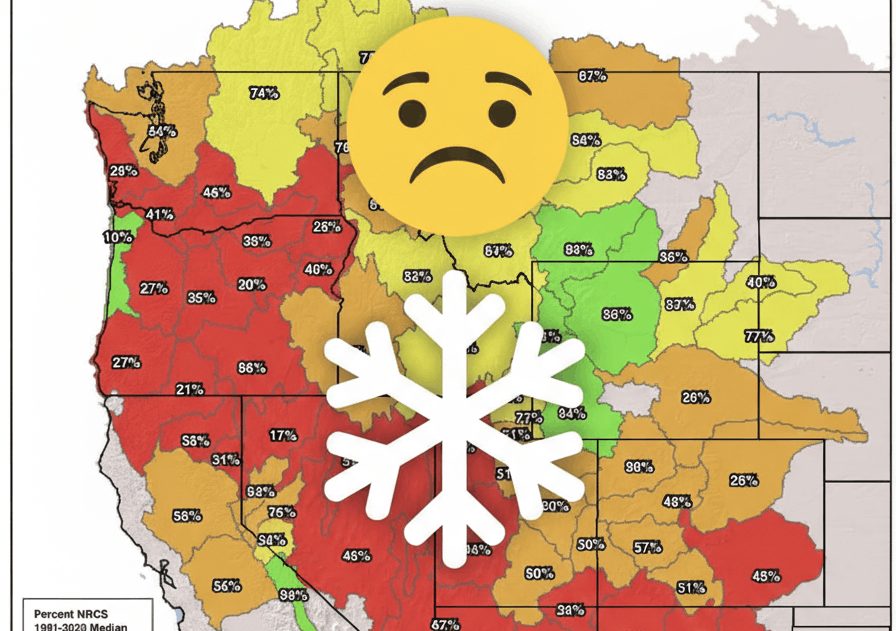
"Snowpack is measured in two main ways: total snow depth and snow-water equivalent (SWE). SWE is especially important because it quantifies the water actually stored in the snow, providing a clearer picture of how much runoff may be available in spring. For instance, 10 feet of dense snow can hold as much water as 20 feet of lighter snow. Let's take a look at the current SWE across the U.S. to see how this early-season snowpack stacks up against the 30-year median."
"Critical Deficits: Nearly all of Oregon, Nevada, Arizona, and New Mexico are in red, indicating snow water levels are less than 50% of the historical median. Widespread Underperformance: Large swaths of Washington, Utah, and Colorado are either red or orange, signaling that these regions are also well below average, mostly ranging between 25% and 69% of normal levels. Isolated Pockets of Normalcy: The only areas of green-representing near-normal levels (90% to 109%)-are in Wyoming, northern Montana, and a small area in the eastern Sierra in California."
Snowpack accumulates as layered snowfall compacts; frequent storms and cold temperatures deepen and strengthen the pack, while warmth or dryness limit accumulation. Two primary measurements are total snow depth and snow-water equivalent (SWE); SWE quantifies the water stored in the snow and better indicates spring runoff potential. Current SWE as a percent of the 30-year median has worsened since last month across much of the West. Nearly all of Oregon, Nevada, Arizona, and New Mexico are under 50% of median, and large areas of Washington, Utah, and Colorado range between 25% and 69%. Only parts of Wyoming, northern Montana, and a small eastern Sierra area are near normal. A contiguous block below 50% stretches from the Pacific Northwest through the Great Basin into the Desert Southwest, signaling broad-scale winter drought for those watersheds. Upcoming storm activity will determine whether basins can recover before spring; without sustained snowfall and cold, many basins may enter spring with substantially reduced water reserves.
Read at SnowBrains
Unable to calculate read time
Collection
[
|
...
]