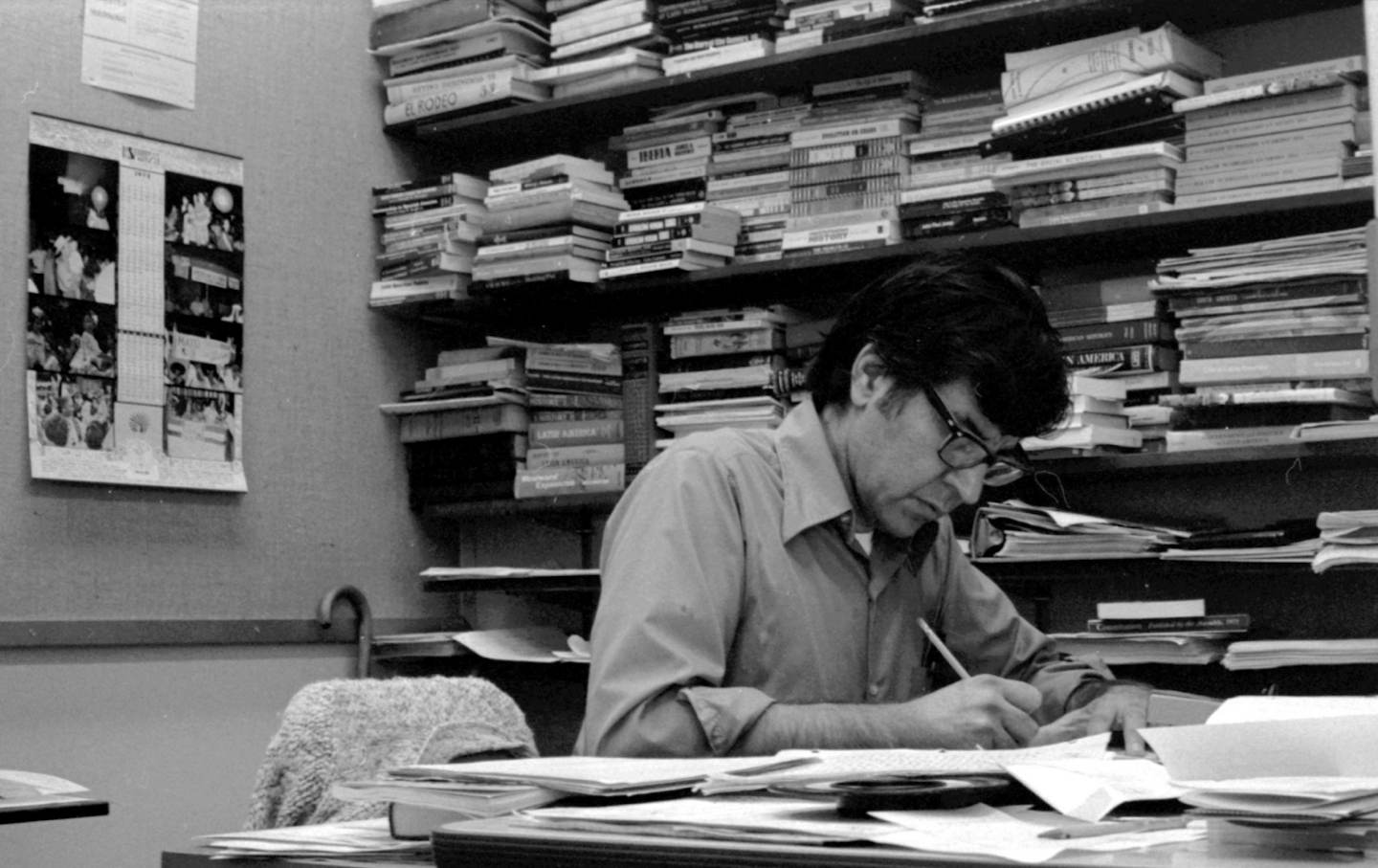
European-settler history was taught as authoritative truth through textbooks, presenting settlers as escaping hardship, Native people as welcoming them, and expansion as “progress.” The Mexican-American War was framed as a “shifted border,” and conquest was treated as destiny. Mexican Americans were left learning someone else’s story. In 1972, Rodolfo “Rudy” Acuña intervened with Occupied America: The Chicanos’ Struggle Toward Liberation, arguing that incomplete or biased historical analyses perpetuated factual errors and degraded Mexican people. Born in 1932 in racist Los Angeles, Acuña experienced exclusion across multiple roles in education. By 1969, he founded Chicano Studies at California State University, Northridge, establishing a major department and building lasting graduate and undergraduate programs.
"They told us this was history. From elementary school through college, it arrived printed in textbooks, laced with authority, taught as truth: European settlers came escaping hardships, Native people welcomed them, and the nation expanded. "Progress" followed. The Mexican-American War became a "shifted border." Conquest became destiny; settlement fact. And we were left to learn their story, not our own."
"Incomplete or biased analyses by historians have perpetuated factual errors and created myths.... The tragedy is that the myths have degraded the Mexican people-not only in the eyes of those who feel superior, but also in their own eyes."
"Born in 1932 in a racist Los Angeles, Acuñ a, who died in March at 93, learned how educational institutions excluded his community. He experienced these structures firsthand as a student, janitor, public school teacher, and community college instructor."
"By 1969, despite fierce resistance-including campus repression, police surveillance, and arrests during student-led struggles to establish Ethnic Studies- he became the founding chair of Chicano Studies at California State University, Northridge (CSUN), establishing the nation's largest department of its kind, authoring over 44 courses in a span of two weeks, and laying the institutional foundation for Chicano Studies and the broader field of Ethnic Studies."
#chicano-studies #ethnic-studies #historical-revisionism #education-inequality #mexican-american-history
Read at The Nation
Unable to calculate read time
Collection
[
|
...
]