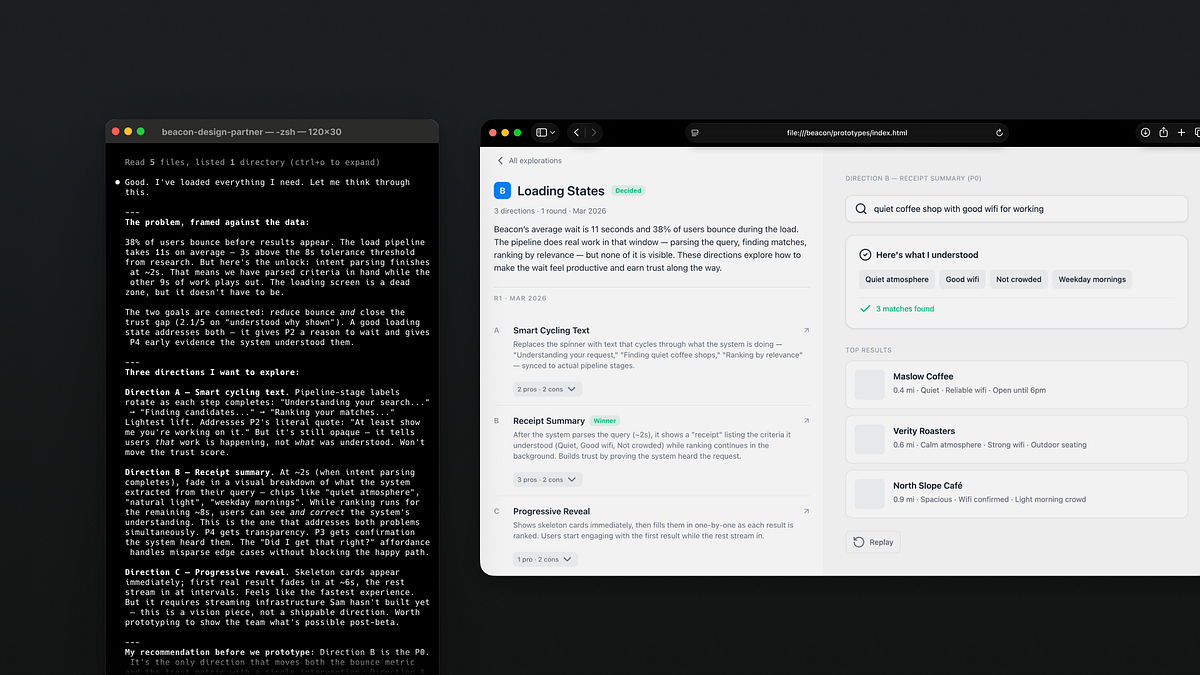
"Working through a complex design problem means holding a lot in my head. Research synthesis, product metrics, a Slack thread with stakeholder feedback, Figma comments, decisions made in the last iteration. Multiply that across iterations, and it's hard to keep up. Most AI tools push toward visual generation. Faster UI, pretty mockups, vibe-coded prototypes. It's fast, and it looks good. But it skips the hard part. I always thought design was about solving problems."
"So what if AI could help me think through the problem instead? Hold all of the project's context and surface the right piece at the right moment. Something that compounds context over a project's life. Like a mind palace? Once set up, I can go from a well-defined problem to a few data-informed code prototypes quickly. Not vibe-coded UI. Concepts grounded in the actual problem and project context. And I'm not using regular AI chat or Projects."
"Project context is scattered across different documents, tools and people. Research lives in one place, product metrics in another, stakeholder feedback in Slack threads I missed. Every design session starts with manual context reassembly. So I built a memory bank out of it. Then I taught Claude Code to use it. my-project/ .claude/ ← skills live here data/ ← research synthesis & metrics (I started with this folder!) design/ ← per-feature folders (round-1/, round-2/, ... for explorations + feedback) project-context/ ← frozen project details (PRD, goals, etc.) handoffs/ ← eng specs prototypes/ ← work"
Design work on complex problems requires tracking research synthesis, product metrics, stakeholder feedback, and prior iteration decisions. Many AI tools emphasize visual generation and fast mockups, but they can skip the harder problem-solving work. A workflow is proposed where AI maintains a “mind palace” of project context and surfaces relevant information at the right moment. With this setup, a designer can move from a well-defined problem to data-informed code prototypes quickly, avoiding vibe-coded UI. The system uses a project context memory bank that consolidates scattered inputs across documents, tools, and people, then teaches Claude Code to use it. The structure includes folders for skills, research and metrics, per-feature explorations, frozen project details, handoffs, and prototypes.
Read at Medium
Unable to calculate read time
Collection
[
|
...
]