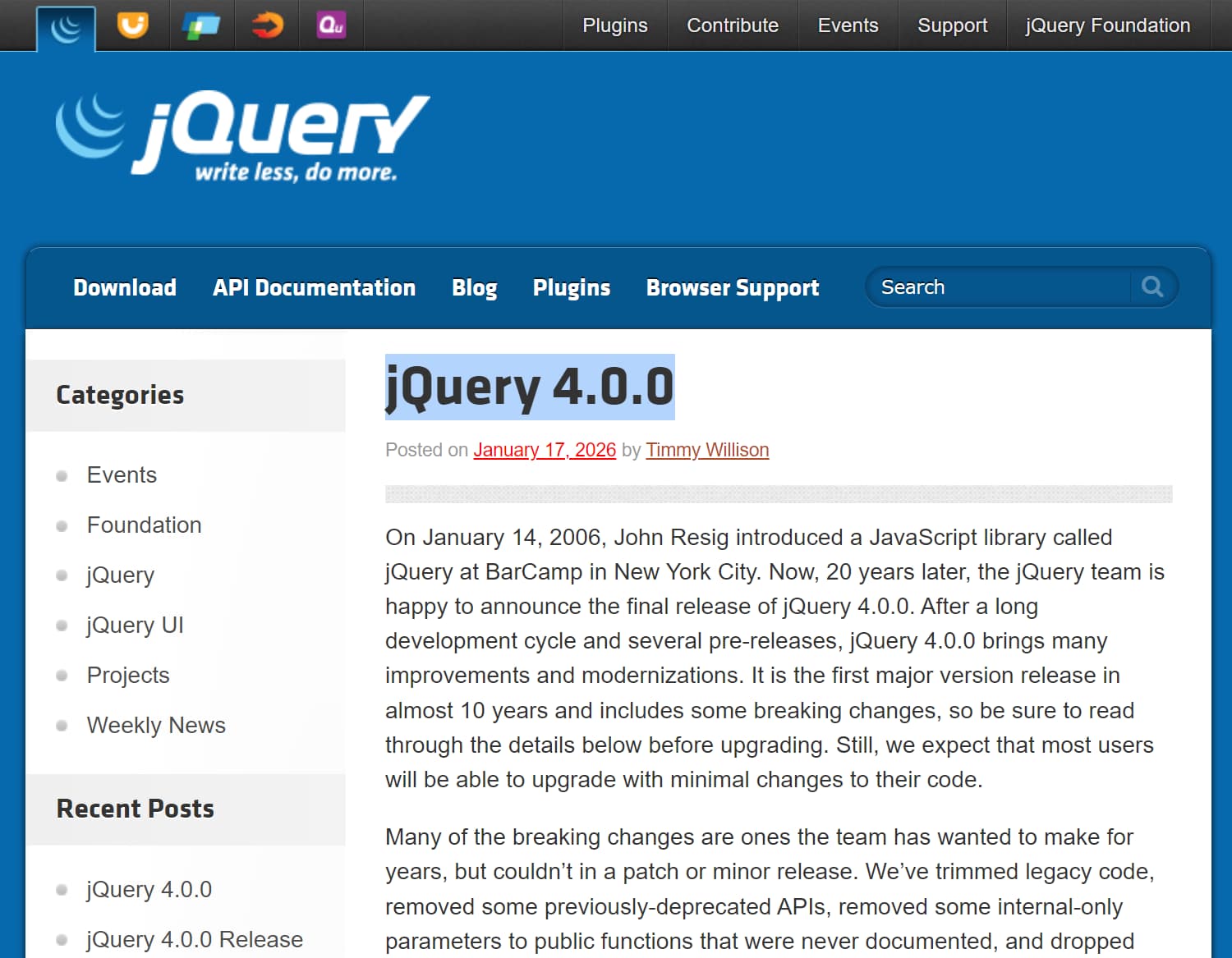
jQuery 4 removes support for Internet Explorer <11, Edge Legacy (non-Chromium), iOS <11, and Firefox <65, enabling removal of legacy workarounds and polyfills. The gzipped distribution is roughly 3KB smaller than 3.7.1 after removing the Sizzle selector engine and IE-specific hooks. The source migrates from AMD/RequireJS to ES Modules (ESM) while retaining a UMD build, improving compatibility with Rollup, Webpack, and Vite. AJAX changes disable automatic promotion of dataType:'json' to JSONP, requiring explicit dataType:'jsonp' to prevent unintended remote code execution. The release emphasizes modernization, smaller footprint, better bundler integration, and tighter AJAX security.
"jQuery 3.x: Supports Internet Explorer 9+, Edge Legacy, iOS 7+, and Firefox 45+. jQuery 4: Removes support for IE < 11, Edge Legacy (non-Chromium), iOS < 11, and Firefox < 65. Impact: The gzipped file size of jQuery 4 is approximately 3KB smaller than 3.7.1. The removal of the Sizzle selector engine (in favor of a native-first approach) and IE-specific hooks contributes to this reduction."
"jQuery 3.x: The source code relies on AMD (Asynchronous Module Definition) and RequireJS. This structure makes it difficult to import specific parts of the source directly into modern bundlers without a build step. jQuery 4: The source code is migrated to ES Modules (ESM). While the distributed file remains a UMD module for compatibility, the source is now compatible with Rollup, Webpack, and Vite. This allows for better integration into modern development workflows."
Read at Jqueryscript
Unable to calculate read time
Collection
[
|
...
]