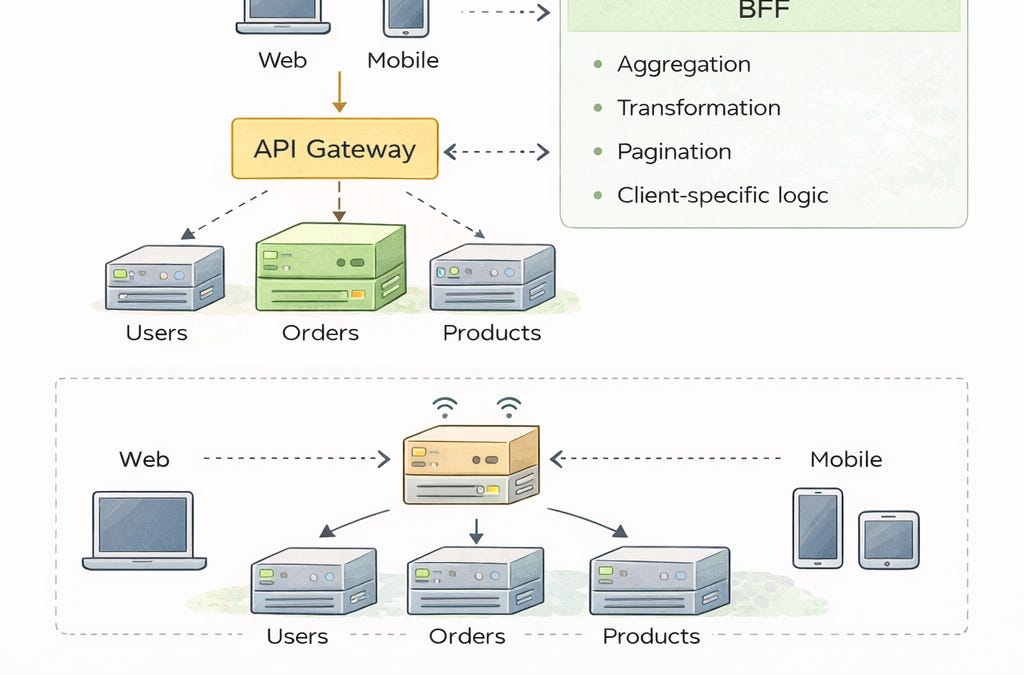
"If the frontend communicates with all these services directly, it ends up responsible for orchestrating multiple requests, transforming responses, handling errors across services, and managing pagination and filtering. Over time, problems appeared. Mobile applications needed smaller responses to reduce network usage and save battery life. Web applications, on the other hand, needed richer data."
"Each BFF became responsible for its own interface. This allowed teams to move faster and adapt APIs to the needs of each platform. Instead of forcing every client to use the same backend contract, each client receives an API tailored to its needs."
"Every BFF service requires infrastructure, monitoring, and maintenance. The system becomes more distributed and slightly more expensive to operate."
The Backend for Frontend pattern addresses challenges when single-page applications require data from multiple backend services with different formats and requirements. Rather than having frontends orchestrate requests, transform responses, and handle errors across services, a BFF acts as a dedicated intermediary tailored to each client's needs. This approach emerged when mobile and web applications required different data structures—mobile needing smaller responses for battery efficiency, web needing richer data. BFFs enable backend teams to move faster by eliminating coordination bottlenecks, allowing each team to maintain their own interface. However, this introduces operational costs through additional infrastructure, monitoring, and maintenance requirements in a more distributed system.
#backend-for-frontend-bff #api-architecture #microservices #client-specific-apis #distributed-systems
Read at Substack
Unable to calculate read time
Collection
[
|
...
]