"Before Russia's 2022 invasion of Ukraine turned it into the new pariah of the West, Iran was the most sanctioned country on Earth: more than 3,600 economic sanctions imposed by the United States, the United Nations, the European Union, and various other countries, measures that forced the Islamic Republic to reshape its economic policy to circumvent these obstacles."
"That included its vital oil sector, which U.S. President Donald Trump hoped to choke through the U.S. blockade of the Strait of Hormuz, the route through which Iran exports 90% of the crude it sells abroad. On April 27, Trump predicted that with tankers stranded in Hormuz and oil storage facilities full, Iran's pipelines and wells would begin to explode within three days."
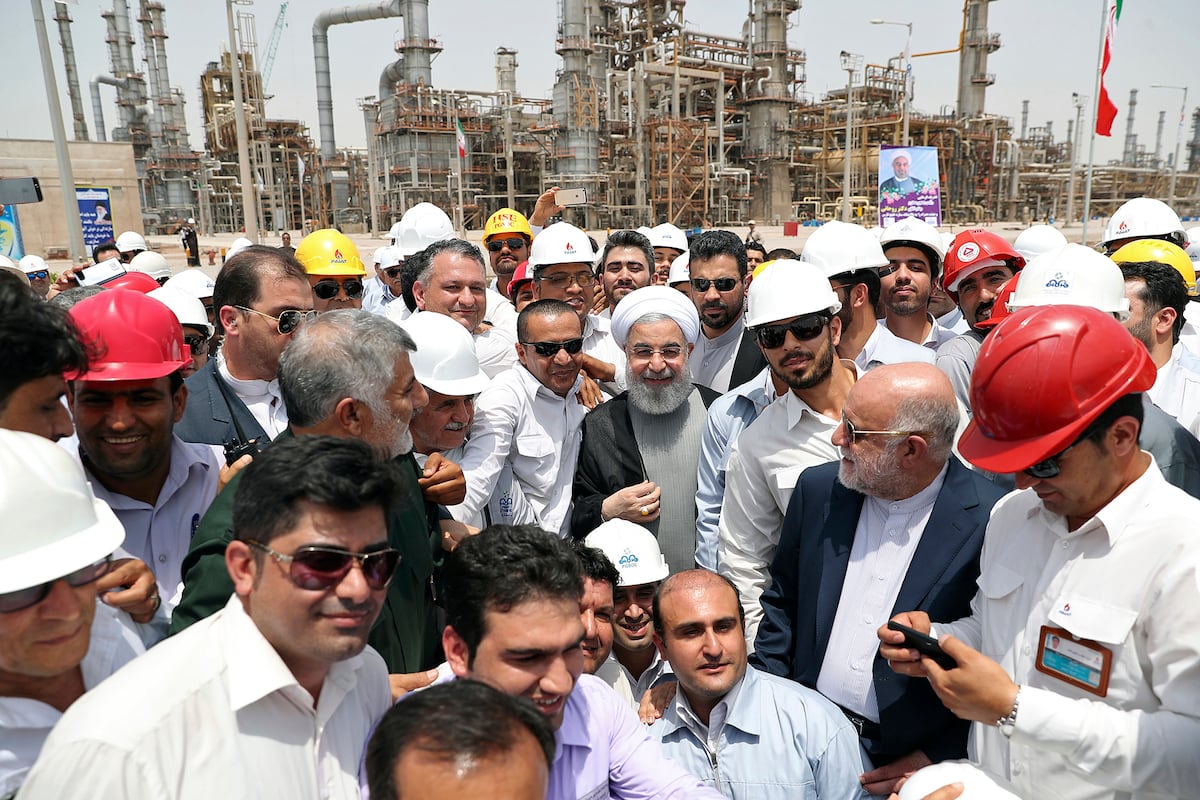
"Two weeks later, there is no sign of such a cinematic scenario. Meanwhile, several experts warn that the timeframe for truly crippling Iran's oil sector by depriving it of the bulk of its exports is not measured in days but likely in months. A photograph taken almost 10 years ago, on April 30, 2017, offers clues as to how Iran's hydrocarbons sector is, for now, weathering the Hormuz blockade without any sign at least none publicly known of the permanent infrastructure damage Trump predicted."
"In that image, Iran's thenpresident, the moderate cleric Hassan Rouhani, smiles flanked by helmeted workers. In the background stand the facilities known as the Persian Gulf Star, in the southern city of Bandar Abbas the world's largest gascondensate refinery, designed to produce fuel for Iran's domestic market and thus reduce the country's gasoline and diesel imports. Very close to its stacks rises another crudeprocessing and petroleumproducts plant: the Bandar Abbas refinery, Iran's third largest."
Iran faced thousands of economic sanctions before the 2022 invasion of Ukraine, forcing changes to its economic policy to bypass restrictions. The U.S. sought to choke Iran’s oil sector by targeting the Strait of Hormuz, through which Iran exports most of its crude. Trump predicted that stranded tankers and full storage would lead to explosions in pipelines and wells within days. Two weeks later, no such public infrastructure damage was evident, and experts warned that crippling Iran’s oil sector would likely take months rather than days. A 2017 photograph shows major hydrocarbon facilities in Bandar Abbas, including the Persian Gulf Star gas-condensate refinery and the Bandar Abbas refinery, indicating operational capacity for domestic fuel production and crude processing.
Read at english.elpais.com
Unable to calculate read time
Collection
[
|
...
]