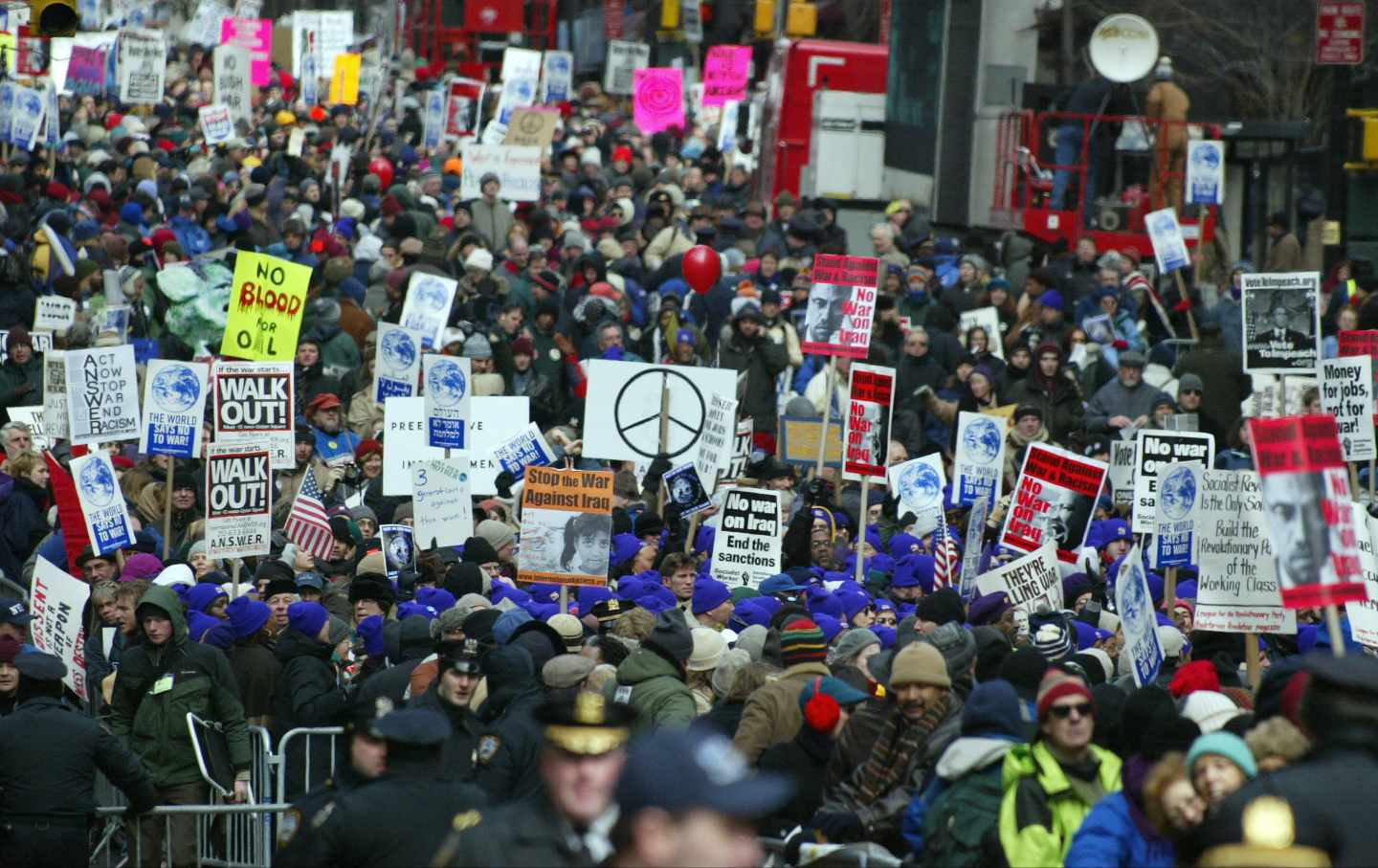
"During a phone call on a warm day in August 2002, the two of us came to an unmistakable conclusion: This bastard is going to take us into war with Iraq! The "bastard," of course, was then President George W. Bush, who was in the midst of an aggressive propaganda campaign about the alleged danger posed by Saddam Hussein's weapons program."
"As we all know now-and many of us knew then-that program did not actually exist. The real threat to the world was sitting in the White House, not in Baghdad. And the two of us knew we had to do something about it. So, along with many other allies, we got to work, helping to form United for Peace & Justice, the largest of the coalitions that mobilized against US aggression in Iraq."
"It is with this background that we offer several thoughts in response to, or, better put, inspired by Eric Blanc's excellent recent essay on the relative lack of a movement against the war in Iran-and the compelling need to build one. To be clear: This period is very different from the early 2000s, above all because we face a genuinely fascistic MAGA movement that makes the Bush/Cheney/Rumsfeld group look like amateurs."
"What that history shows is that the inability to build and sustain an anti-war movement or mass presence is directly linked to the absence of what one might call an anti-imperial/pro-democratic foreign policy on the part of progressive movements. As a result, those who adhere to the notion of a need for peace and justice find ourselves in a Groundhog Day scenario on a regular basis, trying our best to ignite or reignite a mass movement against US aggression each time that aggression raises its ugly head."
A warm August 2002 phone call concluded that President George W. Bush would lead the country into war with Iraq, driven by propaganda about Saddam Hussein’s alleged weapons program. The alleged program did not exist, and the perceived real threat was identified as coming from the White House. In response, allies helped build United for Peace & Justice, a major coalition mobilizing against US aggression in Iraq. The same question is raised about why no mass movement has emerged against the deeply unpopular Iran War amid a highly fascistic MAGA movement. The core explanation offered is that anti-war organizing fails to build and sustain mass presence when progressive movements lack an anti-imperial, pro-democratic foreign policy, repeatedly forcing activists to restart mobilization efforts.
Read at The Nation
Unable to calculate read time
Collection
[
|
...
]