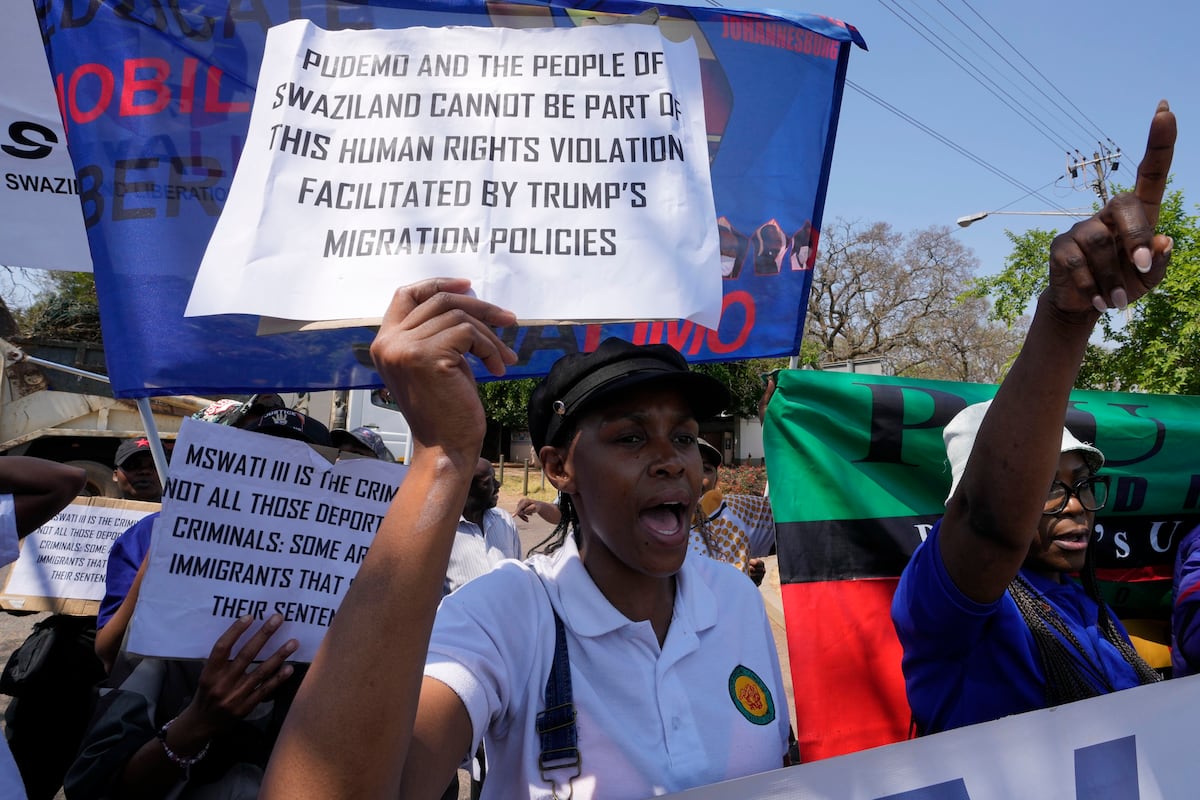
Nearly 100 people attended a High Court hearing in Mbabane where a judge found constitutional questions over Eswatini accepting foreign deportees for millions of dollars. The Chief Justice and a full bench agreed to review the matter, and the full court later postponed its ruling indefinitely. Activists and lawyers view judicial consideration of unconstitutionality as a victory after alleging the agreement was signed in secret and bypassed Parliament. Eswatini received $5.1 million from the U.S., a large sum for a nation of 1.2 million where two-thirds live below the poverty line, and agreed to accept up to 160 deportees.
"Nearly 100 people packed into the sweltering High Court chamber on an early October morning, in Mbabane, the capital of Eswatini, filling the wooden benches and spilling into the aisles. They had come to hear Judge Titus Mlangeni rule on whether accepting foreign deportees from the United States in exchange for millions of dollars violates the nation's own constitution a question that has consumed this landlocked kingdom, formerly known as Swaziland, for months. The case, he declared, raised constitutional questions serious enough towarrant review by the Chief Justice and a full bench of judges."
"The full court met on November 3 and postponed its ruling to an indefinite date. However, the fact that judges are considering the unconstitutionality of receiving deportees has been seen as a significant victory for the activists and lawyers who have spent months challenging a deportation agreement they say was signed in secret, bypassed Parliament, and turned their country into what one critic called a dumping ground for America's unwanted."
"Eswatini received $5.1 million from the U.S., as confirmed in mid-November by Neal Rijkenberg, the finance minister of the African nation, an absolute monarchy. The sum is considerable for this small country of 1.2 million inhabitants, where two-thirds of the population live below the national poverty line. Human Rights Watch cited that figure in September and denounced that, in the agreement signed on May 14, Eswatini committed to accepting up to 160 deportees."
Read at english.elpais.com
Unable to calculate read time
Collection
[
|
...
]