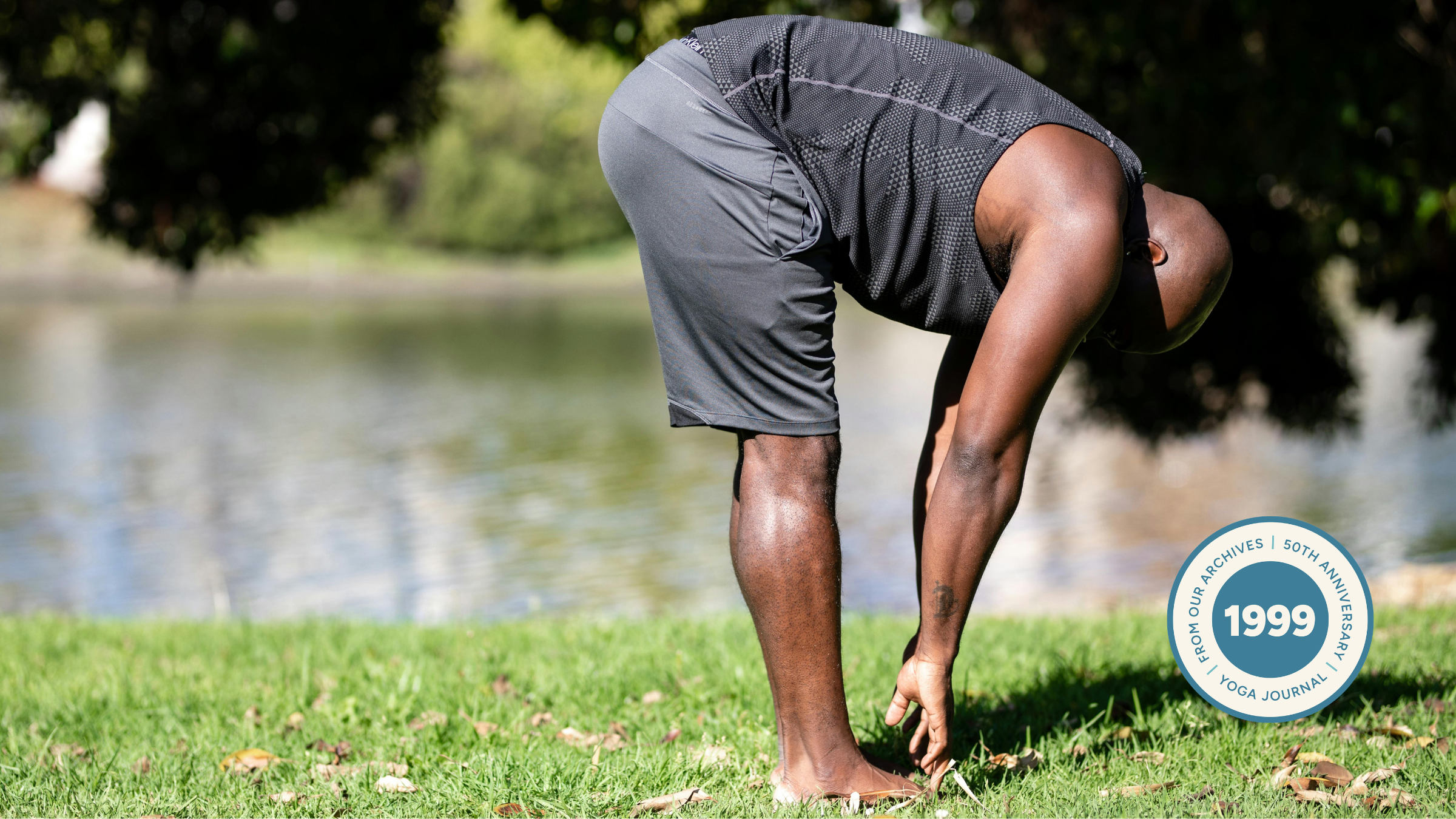
A Sufi story about Nasrudin illustrates looking under the easiest light instead of searching for the real cause. Some yoga students practice regularly yet cannot improve forward bending, often assuming hamstrings are the only limitation. External hip rotator muscles can interfere with forward bends by restricting the movement needed for the hips to open. These muscles include obturator externus and internus, gemellus superior and inferior, piriformis, and quadratus femoris. Though separate, they work together to externally rotate the femur, stabilize the pelvis during walking, and stabilize pelvis and femur when standing on one leg. When bending forward, their combined action can affect how the body folds.
"There is an old Sufi story about philosopher-fool Nasrudin, who was looking for his house keys under a street light. A couple of friends happened by and joined in the search. Finally, in exasperation, one of the friends asked Nasrudin where he thought he had lost the keys. Nasrudin pointed to a spot some distance away where it was extremely dark. But why are we looking here then? he was asked. He replied: because it is so much easier to see under the light."
"This story reveals a common human tendency: to look where we want to instead of digging deeper to reveal the root of a problem. This is true of some yoga students who are trying to move deeper into their forward bends. You attend class regularly, sometimes for years, practice at home, and make progress in most poses-except for forward bending. You seem to have hamstrings of steel! No matter how often or how long you practice, there doesn't seem to be any change in forward bending poses."
"I realized that, like the hamstrings, a group of muscles in the hip area-the external rotators-can interfere with the ability to bend forward. Called the obturator externus and internus, gemellus superior and inferior, piriformis, and quadratus femoris, these muscles are short, broad, and very strong. While each of these muscles is a separate structure, they function as one, working to externally rotate the femur (thigh), stabilize the pelvis during walking, and help stabilize the pelvis and the femur together when you are standing on one leg."
Read at Yoga Journal
Unable to calculate read time
Collection
[
|
...
]