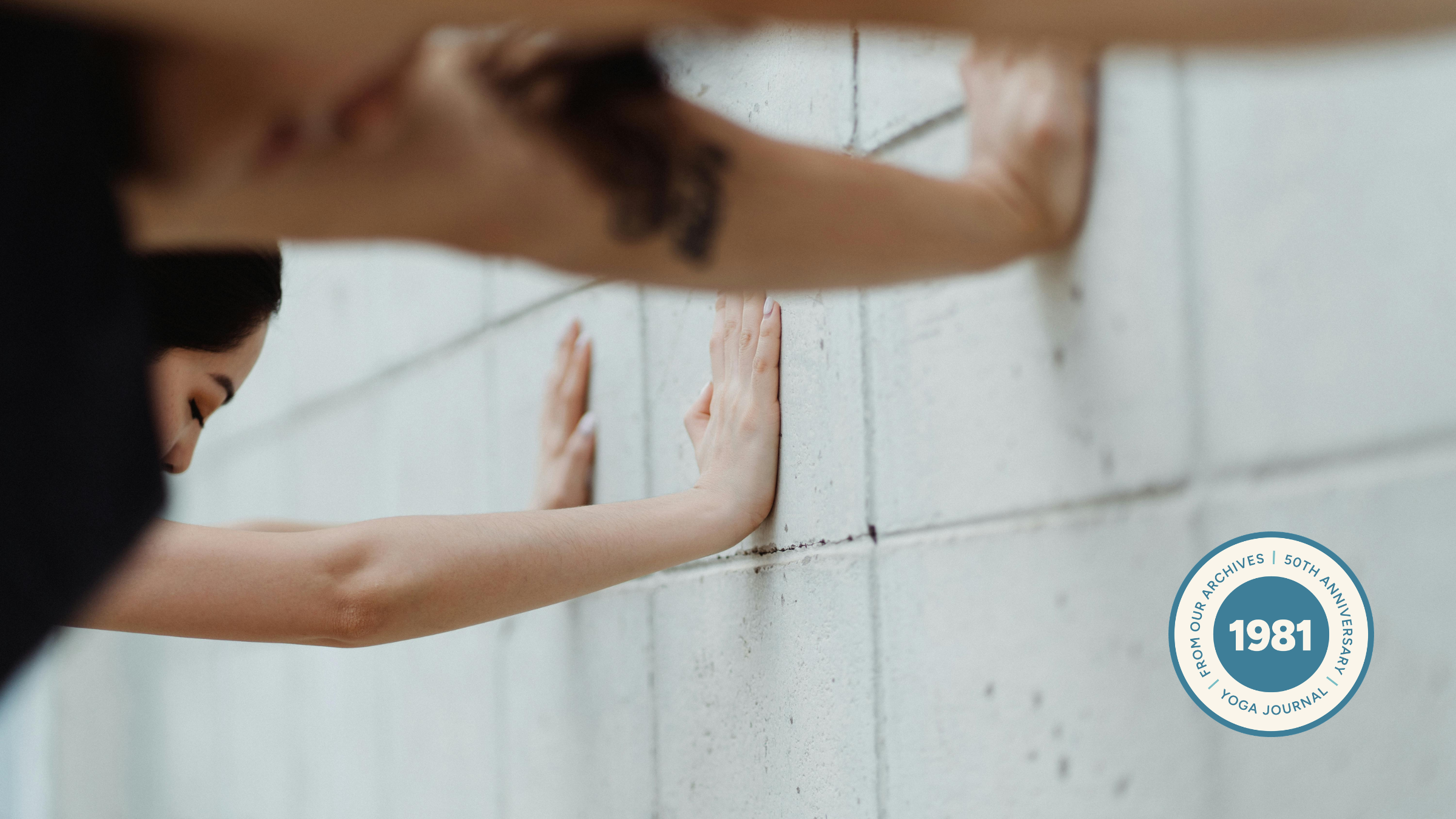
"Walls are a wonderful yoga prop because they are so commonplace. Of course, there are a few drawbacks to using walls for yoga practice, but they're not that serious. For one thing, footprints will eventually appear on your walls five feet above the floor. (These may be difficult to explain to guests or the landlord.) Although I have given up on keeping my own walls clean, I do make a point of washing my feet before practicing in other people's homes. Not everyone views dirty foot marks marching up their walls as an admirable sign of dedication."
"A wall can be used as a prop for the practice of warm-ups as well as standing poses, twists, and inversions. Headstand Students who are beginning the practice of Headstands will generally have difficulty in maintaining their balance. Practicing these poses while supported by a wall, as shown in Figure 1, prevents tumbling backwards. The wall should not become a crutch. When confidence increases, the fear of falling needs to be conquered and practice in the center of the room mastered."
"But even after the student can balance, I feel that occasionally working at the wall still has benefits. I like to walk my heels a few inches further up the wall after I have come into the pose. This helps to create extension of the spine and reminds me how the pose should feel. Too often we think of Headstand as a pose in which all the body's weight comes crushing down on the head."
"Actually, the pose can be one that stretches the body up towards the heavens: the shoulder lifting away from the ears, the pelvis away from the ribs, and the legs ascending out of the torso. When done in this way, Headstand is safer for the neck and more inspiring to the psyche."
Walls serve as a common yoga prop for warm-ups and for standing poses, twists, and inversions. Wall support helps beginners maintain balance in headstands and prevents tumbling backward. The wall should not become a crutch; confidence should grow until practice in the center of the room is mastered. Even after balance improves, moving the heels slightly higher can extend the spine and reinforce the intended sensation of the pose. Headstand can be practiced as an upward stretch rather than weight crushing down on the head, with the shoulder lifting away from the ears, the pelvis away from the ribs, and the legs ascending out of the torso. This approach is described as safer for the neck and more inspiring for the mind.
Read at Yoga Journal
Unable to calculate read time
Collection
[
|
...
]