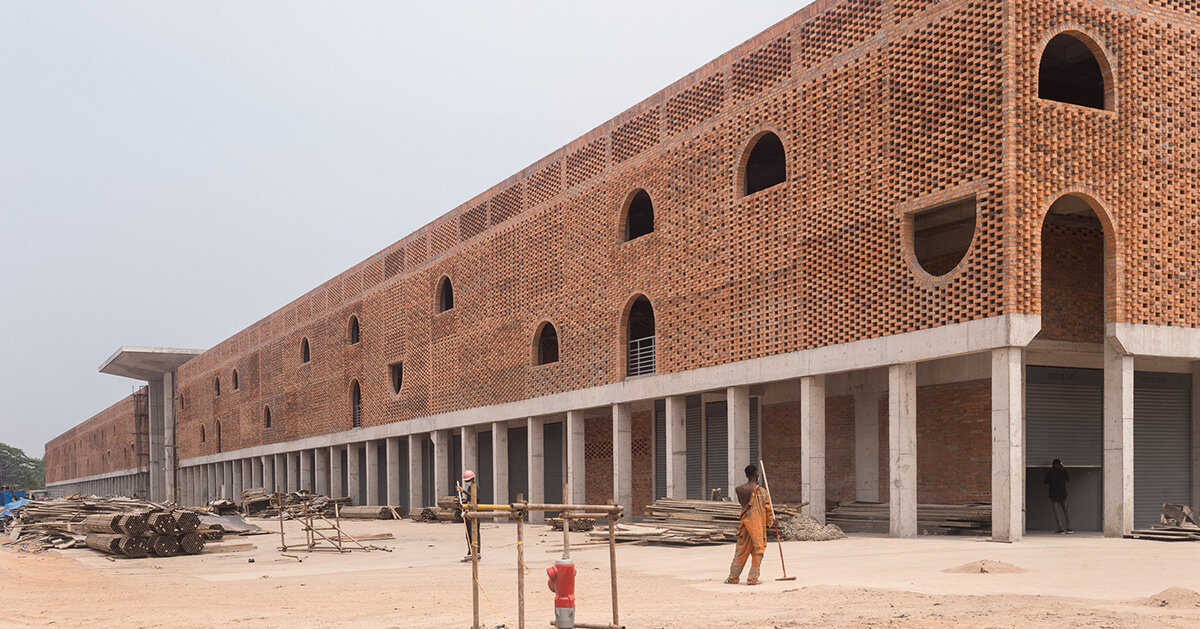
"THINK TANK completes the redevelopment of Kinshasa's historic Zando Central Market in Congo, into a climate-responsive civic infrastructure designed to accommodate 20,000 vendors, nearly six times its original capacity. Once conceived for just 3,500 traders, the 1970s-era market had become dangerously overcrowded, unsanitary, and structurally exhausted. Located in the heart of the Congolese capital, the new 80,500-square-meter complex replaces the former building with a covered yet porous commercial environment that integrates retail, logistics, cold storage, food courts,"
"The structure is composed of open concrete frames topped by large mushroom-shaped slabs, an echo of the former market's iconic roofscape. These canopies protect vendors and shoppers from solar radiation while allowing hot air to escape naturally through height differences in the structure. Terracotta wrap the market, patterned with moucharabieh-like perforations inspired by Congolese textiles. These screens allow air to pass through the building while filtering sunlight, maintaining comfort along the pedestrian walkways without mechanical intervention."
"The redevelopment received the 2025 Foundation Award - Regional Winner (Middle East Africa), with the jury praising its structural clarity, contextual sensitivity, and use of only two primary materials, concrete and terracotta brick. The panel described the project as 'a landmark for Kinshasa,' highlighting its mushroom-shaped slabs and breathable facades as both technically effective and symbolically resonant. Rather than importing mall typologies or air-conditioned commercial models, the Paris-based team at THINK TANK approached the project as an African market first and foremost."
THINK TANK completed the redevelopment of Kinshasa's Zando Central Market into an 80,500-square-meter climate-responsive civic complex accommodating 20,000 vendors. The new market replaces a 1970s-era building that had been conceived for 3,500 traders and had become overcrowded, unsanitary, and structurally exhausted. The program integrates retail, logistics, cold storage, food courts, a fire station, police post, infirmary, and administrative facilities. The structure uses open concrete frames topped by mushroom-shaped slabs to shelter users while promoting natural heat exhaust through height differences. Terracotta screens patterned with moucharabieh-like perforations filter sunlight and allow cross ventilation. The design relies on concrete and terracotta and emphasizes an African market typology over air-conditioned mall models, earning a regional design award.
Read at designboom | architecture & design magazine
Unable to calculate read time
Collection
[
|
...
]