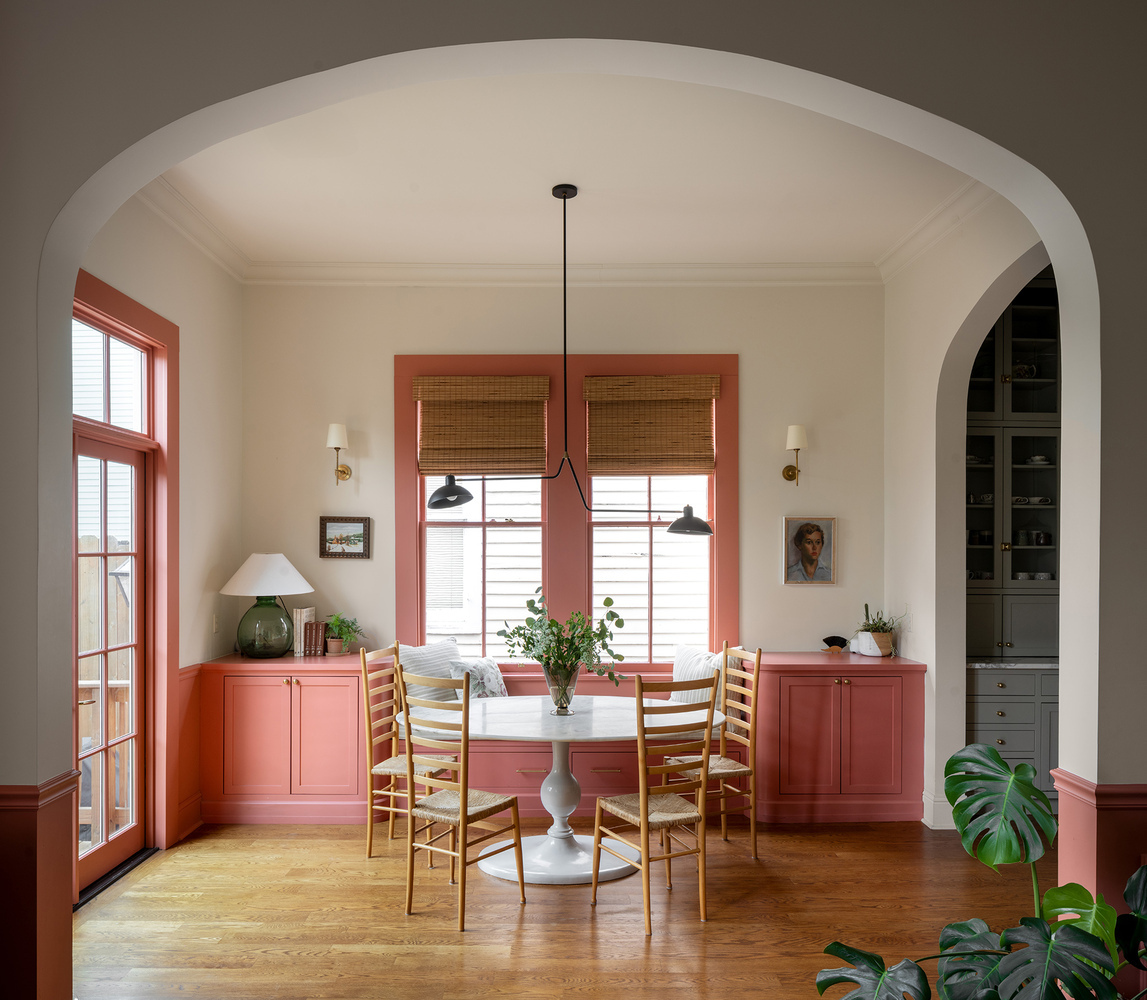
"Breakfast nooks emerged in the early twentieth century in response to increasing domestic density and shifting ideas about everyday life. Rooted in the American Arts and Crafts movement and popularized through bungalow housing of the 1910s and 1920s, they evolved from the more formal Victorian breakfast room into compact, built-in spaces embedded within the kitchen. As houses grew smaller and more economical, architects and millwork companies used fixed benches and tables to occupy corners, alcoves, and bay windows that might otherwise be inefficient."
"With a growing emphasis on domestic flexibility, the Arts and Crafts ideals promoted simpler, family-centered living, bringing meals and everyday tasks into closer proximity to food preparation. Unlike formal dining rooms, which were reserved for guests and special occasions, nooks supported casual meals, homework, and household work throughout the day. Their fixed form reduced circulation and saved effort, thereby allowing multiple activities within a small, clearly defined area."
Breakfast nooks originated in the early twentieth century as compact, built-in kitchen enclosures responding to rising domestic density and changing everyday life. They emerged from the Arts and Crafts movement and bungalow housing, replacing formal Victorian breakfast rooms with fixed benches and tables in corners, alcoves, and bay windows. These light-filled spaces concentrated daily activities, saving circulation and effort while maintaining comfort and spatial clarity. Mid-century homes retained nooks alongside formal dining rooms, but late-twentieth-century open plans and large islands reduced their prevalence. Contemporary housing pressures have revived the concept in flexible forms—banquettes, island edges, bars, and window benches—within open-plan interiors.
Read at ArchDaily
Unable to calculate read time
Collection
[
|
...
]