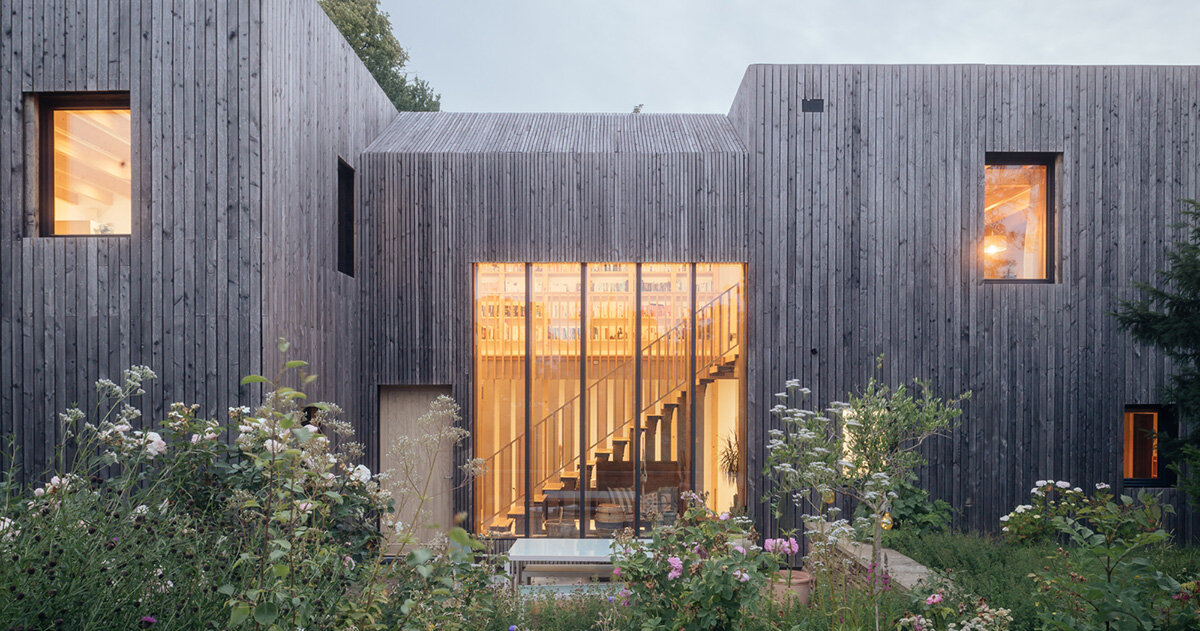
Orchard House by Studio Bark is a three-bedroom sustainable home built on the site of a former working orchard in England's Green Belt. The design comprises two near-cubic volumes connected by a pitched-roof timber bridge, with each cube oriented to capture distinct views—one facing east across fields, the other toward woodland. The bridge creates a double-height internal 'street' serving as a transition between living spaces. Bedrooms occupy the lower level with restrained glazing, while kitchen, dining, and living areas sit above beneath exposed timber beams. The home was designed under Paragraph 84 of the National Planning Policy Framework, which permits isolated countryside dwellings that are high-quality and environmentally sustainable. Three years after completion, replanted local species have reestablished the orchard's structure and productivity.
"The design by Studio Bark is composed of two near cubic volumes set apart and connected by a pitched-roof timber bridge. The architects orient each cube to frame distinct views, one facing east across open fields, the other turning southwest toward woodland. Between them, a double height link forms a quiet internal 'street' lined with bookshelves and rooflights."
"The home was conceived under Paragraph 84 of the National Planning Policy Framework, a policy which restricts isolated new homes in the countryside, while allowing exceptions for dwellings that are high-quality and environmentally sustainable."
"The bedrooms occupy the lower level, where ceilings are lower and glazing more restrained, maintaining cool internal conditions. Above, kitchen, dining, and living areas sit beneath exposed timber beams and generous openings, creating an upside down arrangement that brings family life into the canopy of the orchard."
#sustainable-architecture #green-belt-development #orchard-restoration #contemporary-design #environmental-planning
Read at designboom | architecture & design magazine
Unable to calculate read time
Collection
[
|
...
]