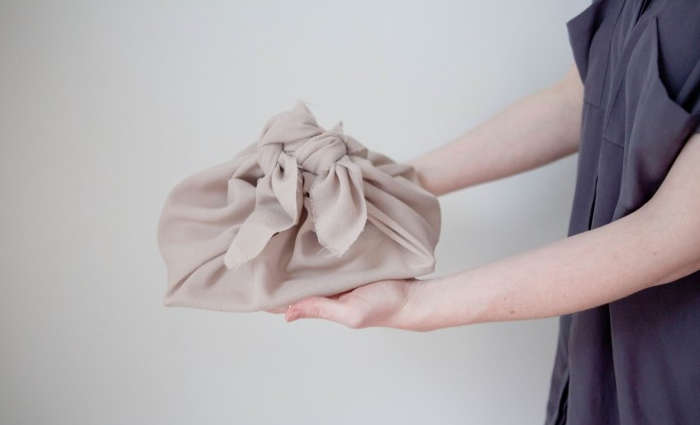
A friend arrived at a dinner party with a bottle of wine, half a loaf of bread, and six Bosc pears, each bundled in specifically-knotted furoshiki cloth wraps. The wrapping prevented the bottle from smashing into the pears during the walk and made the packages feel like gifts. Furoshiki is a centuries-old Japanese tradition for bundling and transporting belongings and offers a waste-free alternative to disposable wrapping. Furoshiki adapts to almost any object using simple knots and folds that are easy to master. A basic wrap places the object in the center of a square cloth, knots two opposite corners together, then knots the remaining corners above to form a satchel.
"Once, at a dinner party, I was entranced when a friend unpacked her backpack to reveal each of her dinner contributions: a bottle of wine, half a loaf of fresh bread, and six Bosc pears, each group intricately bundled in specifically-knotted furoshiki cloth wraps. The wrapping was not only practical, preventing the wine bottle from smashing into the delicate pears on her walk over, but also elevated the whole experience and made the packages feel like gifts."
"Furoshiki is a centuries-old tradition in Japan, and a way to bundle and transport belongings and presents. It's waste-free too-which explains why the Japanese Ministry of the Environment issued a pamphlet detailing the different techniques to use depending on what you want to wrap. Furoshiki can be applied to just about any object, large or small, and uses simple knots and folds, all of which are fairly easy to master."
"Place your object in the center of the furoshiki (most are pre-cut square cloths sized anywhere from 18 to 45 inches; you can easily make your own-any knottable fabric works). Take two opposite corners of the square and tie them into a knot in the center; if the ends are long you can tuck them in. Then take the other two opposite corners and knot them just above the first knot."
Read at Remodelista
Unable to calculate read time
Collection
[
|
...
]