#actor-model

[ follow ]
#scala
Scala
fromMedium
1 week ago

Scala's Growth Model - Building Inward, Starving Outward

Scala's ecosystem excels internally but struggles to attract new users due to structural and cultural barriers.
Scala
fromMedium
1 week ago

100 Scala Interview Questions and Answers for Technical and Functional Roles

Preparing for a Scala interview requires understanding functional programming concepts and structured questions for effective evaluation.
Scala
fromScala-lang
2 weeks ago

Scala 3.8.3 is now available!

Scala 3.8.3 introduces local coverage exclusions and a safe mode for capability-safe code, enhancing code safety and coverage measurement.
Scala
fromScala-lang
3 weeks ago

Porting the Scala 2 optimizer to Scala 3

The Scala 3 compiler's optimizer improves performance by 10-30% for high-level functional code without complicating developer tasks.
Scala
fromMedium
2 months ago

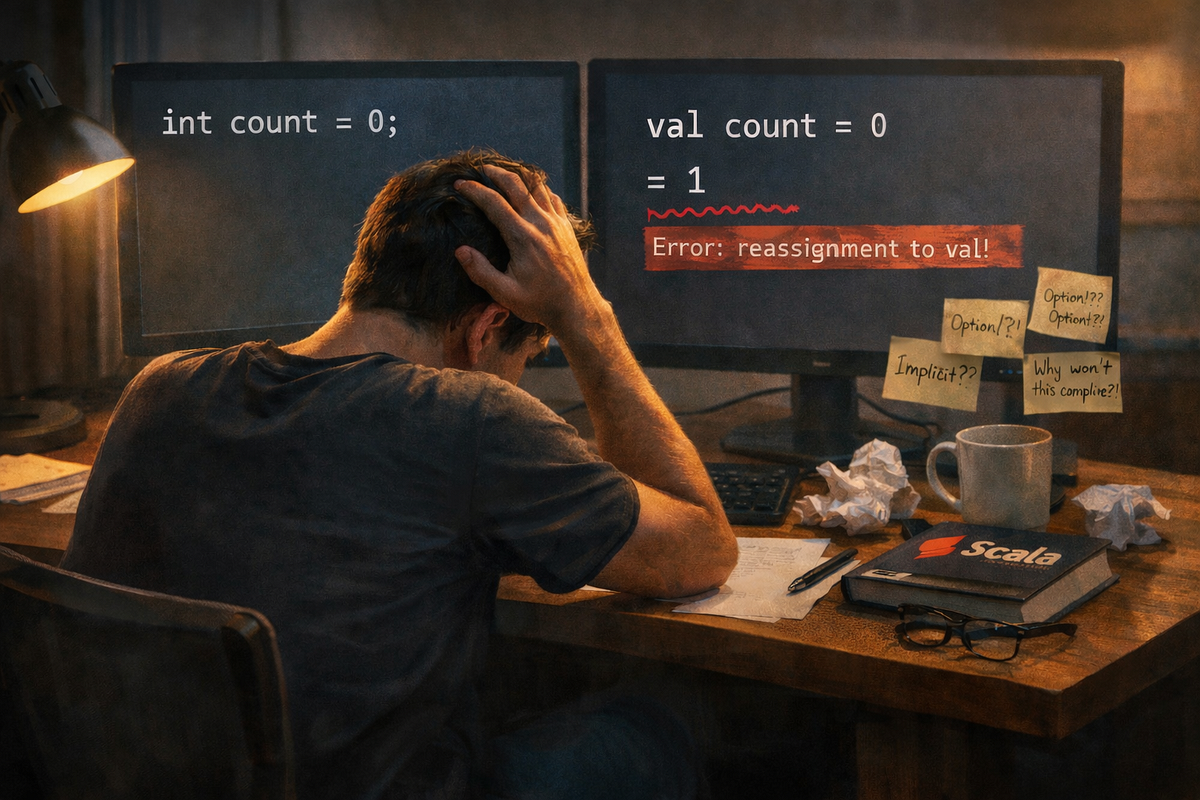
I Thought Scala Was Vibe Coding

Scala emphasizes immutability, expression-oriented programming, powerful pattern matching, and Option-based null safety for more concise, safer, and more composable JVM code.
Angular
fromMedium
2 days ago

Junior Scala Developer Resume Samples Optimized for Employers

Present existing work effectively to demonstrate capability for junior Scala roles.
Scala
fromMedium
1 week ago

Scala's Growth Model - Building Inward, Starving Outward

Scala's ecosystem excels internally but struggles to attract new users due to structural and cultural barriers.
Scala
fromMedium
1 week ago

100 Scala Interview Questions and Answers for Technical and Functional Roles

Preparing for a Scala interview requires understanding functional programming concepts and structured questions for effective evaluation.
Scala
fromScala-lang
2 weeks ago

Scala 3.8.3 is now available!

Scala 3.8.3 introduces local coverage exclusions and a safe mode for capability-safe code, enhancing code safety and coverage measurement.
Scala
fromScala-lang
3 weeks ago

Porting the Scala 2 optimizer to Scala 3

The Scala 3 compiler's optimizer improves performance by 10-30% for high-level functional code without complicating developer tasks.
fromScala-lang
5 days ago

Last mile towards sbt 2

sbt 2.x uses Scala 3.x for build definitions and plugins, while still supporting Scala 2.x. It embraces a simpler build.sbt via common settings and introduces an incremental test feature.
Scala
Software development
fromMedium
6 days ago

Async Logging Is Not a Silver Bullet - What Actually Limits Performance

Async logging redistributes costs rather than reducing them, impacting performance in different ways depending on implementation.
fromInfoQ
1 week ago

Latency: The Race to Zero...Are We There Yet?

In the fintech industry we can link latency directly to profit and money. If I have lower latency than the competition, I can get to the better deals, I can make the better deals.
Venture
Java
fromScala.js
2 weeks ago

Announcing Scala.js 1.21.0

Scala.js 1.21.0 introduces compatibility changes, deprecates JDK < 17, disables Google Closure Compiler by default, and includes performance improvements.
Software development
fromInfoQ
1 week ago

Stateful Continuation for AI Agents: Why Transport Layers Now Matter

Transport layer efficiency is crucial for agent workflows, as multi-turn interactions significantly increase overhead compared to single-turn LLM use.
fromYcombinator
2 weeks ago

Show HN: QuickBEAM - run JavaScript as supervised Erlang/OTP processes | Hacker News

QuickBEAM runs JavaScript inside OTP supervision trees, allowing each runtime to function as a process with a `Beam` global that can call Elixir code and send/receive messages.
Scala
fromInfoQ
2 weeks ago

Beyond RAG: Architecting Context-Aware AI Systems with Spring Boot

Context-Augmented Generation (CAG) enhances Retrieval-Augmented Generation (RAG) by managing runtime context for enterprise applications without requiring model retraining.
fromInfoWorld
1 month ago

We mistook event handling for architecture

Events are essential inputs to modern front-end systems. But when we mistake reactions for architecture, complexity quietly multiplies. Over time, many front-end architectures have come to resemble chains of reactions rather than models of structure. The result is systems that are expressive, but increasingly difficult to reason about.
React
#java
Java
fromMedium
3 weeks ago

Java vs Kotlin vs Scala: Which to Choose in 2026

Java, Kotlin, and Scala serve different audiences and problems despite running on the JVM.
fromInfoQ
2 months ago
Java

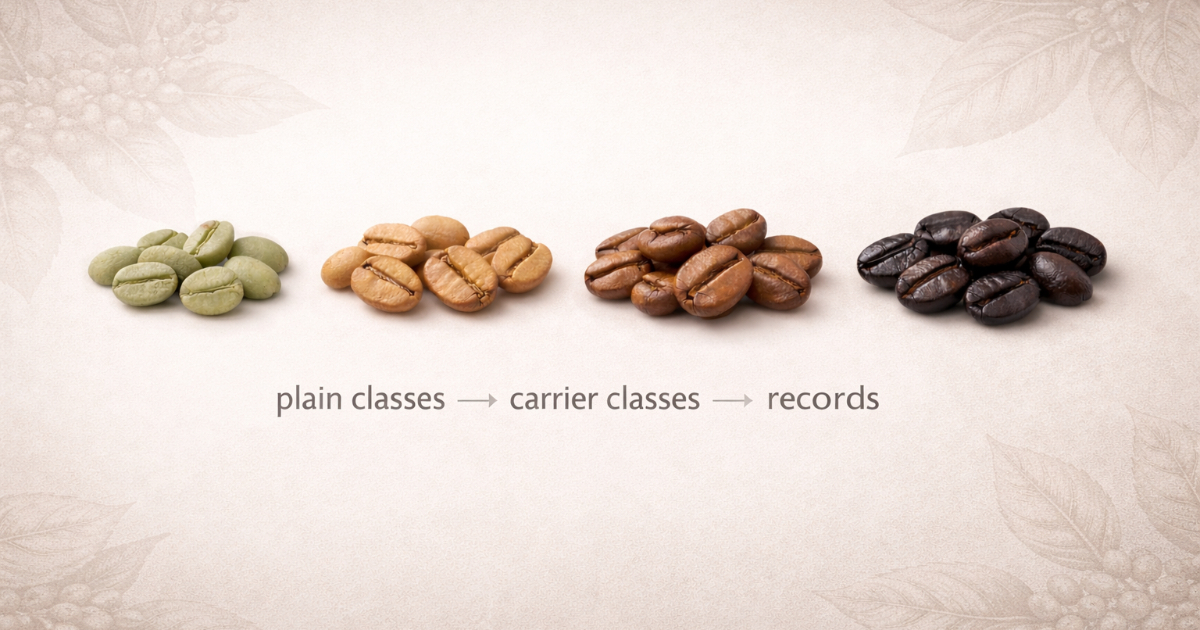
Java Explores Carrier Classes to Extend Data-Oriented Programming Beyond Records

Java
fromMedium
3 weeks ago

Java vs Kotlin vs Scala: Which to Choose in 2026

Java, Kotlin, and Scala serve different audiences and problems despite running on the JVM.
fromInfoQ
2 months ago
Java

Java Explores Carrier Classes to Extend Data-Oriented Programming Beyond Records

Java
fromMedium
4 weeks ago

Spark Internals: Understanding Tungsten (Part 2)

Catalyst Optimizer and Tungsten work together in Apache Spark to optimize data execution and manage raw binary data.
DevOps
fromInfoQ
1 month ago

QCon London 2026: Uncorking Queueing Bottlenecks with OpenTelemetry

Distributed tracing with OpenTelemetry enables engineers to identify root causes across service boundaries by maintaining hierarchical visibility of operations, while SLOs based on latency provide more reliable alerting than infrastructure metrics.

#scala-3
Scala
fromMedium
3 weeks ago

Unmasking AnyKind: Type Shapes in Scala 3

AnyKind in Scala 3 allows for a supertype of all types, but lacks specificity about type kind.
Scala
fromMedium
3 weeks ago

Unmasking AnyKind: Type Shapes in Scala 3

AnyKind in Scala 3 allows for a supertype of all types, but lacks specificity about type kind.
DevOps
fromInfoQ
1 month ago

QCon London 2026: Managing Asynchronous APIs at Scale

Event-driven architectures require explicit specifications, governance, and provisioning practices to scale beyond informal ad-hoc approaches, using tools like AsyncAPI to enable discovery, schema consistency, and automated infrastructure deployment.
Java
fromInfoWorld
1 month ago

9 reasons Java is still great

Java maintains prominence through balancing stability with innovation, community-driven governance via the Java Community Process, and continuous evolution incorporating functional programming, concurrency, and cloud computing advances.
#scala-interview-preparation
Scala
fromMedium
3 weeks ago

Breaking Scala's Nil with Java Reflection

Java reflection in Spring Data MongoDB caused a bug in Scala's Nil singleton, revealing a mismatch between Scala's guarantees and JVM behavior.
fromMedium
1 month ago

Scala Profiling Under Fire

While the codebase is fresh and grows fast under the umbrella of the local environment, we tend to rely on debugging tools, which were created specifically for that purpose. The app is half-baked, and the code is split open. We observe it through the lens of our IDE and with the speed of our brain. Everything is possible; we may pause execution for minutes, and the whole system is a white box - an open book for us.
Software development
Scala
fromInfoQ
4 weeks ago

QCon London 2026: Introducing Tansu.io -- Rethinking Kafka for Lean Operations

Tansu is an open-source, stateless messaging broker that replaces Kafka's complex architecture with a simpler, durable storage model.
Scala
fromMedium
1 month ago

What I Learned Building Secure Observability in Scala

Build secure Scala applications by keeping core logic in plain IO and using a temporary Mission Stack only for sensitive operations, integrating security with observability from the start rather than adding it later.
Web development
fromInfoWorld
2 months ago

5 ways to use JavaScript promises

Promises provide a simple, standardized mechanism to handle asynchronous operations in JavaScript by using resolve and reject to deliver results or errors.
#functional-programming
Artificial intelligence
fromInfoQ
2 months ago

[Video Podcast] The Craft of Software Architecture in the Age of AI Tools

Software architecture must be rethought for the age of AI tools, integrating design, platforms, APIs, delivery, and practical experiential guidance for real-world practitioners.
Scala
fromMedium
1 month ago

100 Scala Scenario-Based Interview Questions and Answers

Scala technical interviews prioritize practical problem-solving and design reasoning over syntax memorization, with scenario-based questions evaluating real-world technical capabilities.
JavaScript
fromLogRocket Blog
2 months ago

A guide to async/await in TypeScript - LogRocket Blog

TypeScript supports asynchronous programming through promises, async/await, and modern patterns like for await...of, AbortController, and Promise.all for concurrency and cancellation.
Software development
fromMedium
3 months ago

Agentic Workflows in Scala (Without the Buzzwords)

Durable, decision-driven systems require explicit state, clear decision points, and explicit workflow orchestration rather than opaque autonomous agent loops.
Web frameworks
fromInfoWorld
2 months ago

Reactive state management with JavaScript Signals

Signals provide fine-grained reactive state that pushes updates efficiently, simplifying state management and reducing framework rendering overhead.
Data science
fromDevOps.com
2 months ago

Why Data Contracts Need Apache Kafka and Apache Flink - DevOps.com

Data contracts formalize schemas, types, and quality constraints through early producer-consumer collaboration to prevent pipeline failures and reduce operational downtime.
Artificial intelligence
fromInfoQ
2 months ago

Autonomous Big Data Optimization: Multi-Agent Reinforcement Learning to Achieve Self-Tuning Apache Spark

A Q-learning agent autonomously learns and generalizes optimal Spark configurations by discretizing dataset features and combining with Adaptive Query Execution for superior performance.
Web frameworks
fromLoicpoullain
1 month ago

The future of web frameworks in the age of AI

AI agents now generate 90-95% of production code, requiring frameworks to be AI-understandable with comprehensive documentation and clear examples to remain competitive.
fromInfoWorld
2 months ago

The 'Super Bowl' standard: Architecting distributed systems for massive concurrency

When I manage infrastructure for major events (whether it is the Olympics, a Premier League match or a season finale) I am dealing with a &quot;thundering herd&quot; problem that few systems ever face. Millions of users log in, browse and hit &quot;play&quot; within the same three-minute window. But this challenge isn't unique to media. It is the same nightmare that keeps e-commerce CTOs awake before Black Friday or financial systems architects up during a market crash. The fundamental problem is always the same: How do you survive when demand exceeds capacity by an order of magnitude?
DevOps
fromInfoWorld
2 months ago

Get started with Angular: Introducing the modern reactive workflow

Angular is a cohesive, all-in-one reactive framework for web development. It is one of the larger reactive frameworks, focused on being a single architectural system that handles all your web development needs under one idiom. While Angular was long criticized for being heavyweight as compared to React, many of those issues were addressed in Angular 19. Modern Angular is built around the Signals API and minimal formality, while still delivering a one-stop-shop that includes dependency injection and integrated routing.
Web frameworks
Software development
fromTypelevel
1 month ago

typelevel.org built with Typelevel

Arman Bilge leads and maintains core Typelevel projects like Cats Effect, directs the Typelevel Foundation, and focuses on functional programming, concurrent runtimes, community growth, and open-source collaboration.
Scala
fromScala-lang
1 month ago

Hardening Scoverage Support in Scala 3

Scoverage, Scala's standard code coverage tool, underwent systematic testing improvements to ensure reliability across compiler language features and future compatibility.
fromMedium
2 months ago

Monadris: Why Functional Design Makes Tetris Safer and Easier (Scala 3 + ZIO)

A real Tetris loop has time (ticks), concurrent inputs (keystrokes), state transitions (collision, locking, line clears), and non-determinism (piece generation). In many imperative designs, these concerns end up tangled in shared mutable state, which tends to produce bugs that are: hard to reproduce (timing-dependent), hard to test (logic mixed with effects), hard to debug (replay isn't deterministic).
Software development
fromMedium
2 months ago

When Kafka Lag Lies: A Production Debugging Story

Uncommitted Kafka offsets can cause persistent consumer-group lag even when ingestion is low, databases are idle, and no errors are observed.
fromMedium
3 months ago

Agentic Workflows in Scala (Without the Buzzwords)

High-level view of the travel search workflow, highlighting parallel searches, explicit decision points, and iterative refinement. In Scala, we define this workflow using Workflows4s, encoding both state and transitions explicitly in the type system. Instead of opaque state blobs or untyped contexts, the state of the process is represented using algebraic data types - types like Started, Found, Sent, and Booked - each corresponding to a distinct point in the workflow's lifecycle.
Scala
fromMedium
2 months ago

Two Months of Vibe-Coding: Scala, Constraints, Trust and Shipping

If there's one thing I want you to take away from this article, it's this: testing harness is the most important thing for vibe-coding. Not prompt engineering, not fancy plugins, just constraining your AI outside AI toolchain. I'm calling it harness because it's not only tests. It's tests, types, linters, and any other automated checks you can put in place. The more you rely on AI, the more harness you need.
Software development
fromMedium
2 months ago

I Can't Believe Rust Is Replacing Java

The X recommendation system was fully rewritten and open-sourced using only Rust and Python, replacing previous Java and Scala implementations.
fromScala-lang
2 months ago

Scala 3.8 released!

We're pleased to announce the release of Scala 3.8 - a significant release that modernizes the Scala ecosystem and paves the way for Scala 3.9 LTS. This release introduces a standard library compiled by Scala 3 itself, stabilizes highly-anticipated features like Better Fors (SIP-62) and runtimeChecked (SIP-57), and introduces experimental features including flexible varargs and strict equality pattern matching. A runtime regression was detected after publishing Scala 3.8.0 artifacts.
Scala
fromMedium
1 year ago

Modern Web Architectures: Composability with Harmony

Over the past decade, software development has undergone a massive transformation due to continuous innovations in tools, processors and novel architectures. In the past, most applications were monoliths and then shifted to microservices, and now we find ourselves embracing composability - a paradigm that prioritizes modular, reusable, and flexible software design. Instead of writing separate, tightly coupled applications, developers now compose software using reusable business capabilities that can be plugged into multiple projects. This enables greater scalability, maintainability, and collaboration across teams and organizations. At the heart of this movement is Bit Harmony, a framework designed to make composability a first-class citizen in modern web development.
Software development
fromThegreenplace
2 months ago

Compiling Scheme to WebAssembly

One of my oldest open-source projects - Bob - has celebrated 15 a couple of months ago. Bob is a suite of implementations of the Scheme programming language in Python, including an interpreter, a compiler and a VM. Back then I was doing some hacking on CPython internals and was very curious about how CPython-like bytecode VMs work; Bob was an experiment to find out, by implementing one from scratch for R5RS Scheme.
fromArmin Ronacher's Thoughts and Writings
2 months ago

A Language For Agents

Last year I first started thinking about what the future of programming languages might look like now that agentic engineering is a growing thing. Initially I felt that the enormous corpus of pre-existing code would cement existing languages in place but now I'm starting to think the opposite is true. Here I want to outline my thinking on why we are going to see more new programming languages and why there is quite a bit of space for interesting innovation.
Software development
fromInfoWorld
2 months ago

Why your next microservices should be streaming SQL-driven

Streaming SQL with UDFs, materialized results, and ML/AI integrations enables continuous, stateful processing of event streams for microservices.
fromTypelevel
1 month ago

Custom Error Types Using Cats Effect and MTL

This stands in contrast to bifunctor or polyfunctor techniques, which add a typed error channel within the monad itself. You can see this easily in type signatures: IO[String] indicates an IO which returns a String or may produce a Throwable error ( Future[String] is directly analogous). Something like BIO[ParseError, String] would represent a BIO that produces a String or raises a ParseError.
Scala
[ Load more ]