#extreme-ultraviolet

[ follow ]
OMG science
fromFuturism
2 days ago

Astronomers Create Entire Synthetic Universe "Indistinguishable" From Our Own

Astronomers created a synthetic universe to test the standard cosmological model, demonstrating its effectiveness in explaining galaxy formation.
Science
fromTechCrunch
2 days ago

AI galaxy hunters are adding to the global GPU crunch | TechCrunch

NASA will launch the Nancy Grace Roman space telescope in September 2026, providing 20,000 terabytes of data to astronomers.
fromNature
4 days ago

Efficiency-optimized relativistic plasma harmonics for extreme fields - Nature

The generation of coherent extreme ultraviolet and X-ray photons by high harmonic generation from solid targets relies on the formation of a steep electron density gradient tuned by the leading edge of a relativistically intense laser pulse interacting with a bulk, solid-density target.
Science
Science
fromMail Online
1 week ago

Britain's worst-case space weather scenario laid bare

A solar superstorm could cause widespread electrical blackouts and disrupt critical electronic systems in the UK.
Photography
fromBig Think
2 weeks ago

Something special is happening in space right now

Artemis II marks humanity's return to the Moon with a diverse crew, highlighting Earth's fragility and the potential for peace.
OMG science
fromNature
1 week ago

Venus's impenetrable haze could be made of cosmic dust

The haze beneath Venus's acidic clouds is composed of particles from outer space.
#space-mirrors
Science
fromMail Online
2 weeks ago

Launching 50,000 mirrors into space will 'significantly' disrupt sleep

Launching 50,000 mirrors into space for sunlight could disrupt sleep and ecosystems on a planetary scale.
Science
fromMail Online
2 weeks ago

Launching 50,000 mirrors into space will 'significantly' disrupt sleep

Launching 50,000 mirrors into space for sunlight could disrupt sleep and ecosystems on a planetary scale.
#gravitational-waves
OMG science
fromBig Think
3 weeks ago

Ask Ethan: Do gravitational waves redshift like light does?

Gravitational waves, like light waves, can experience redshifts and blueshifts due to various intervening effects during their transit.
OMG science
fromwww.scientificamerican.com
1 month ago

A boom in gravitational waves leaves scientists with more questions than answers

A global network of gravitational-wave observatories has detected 218 candidate events, revealing complex structures in cosmic mergers and providing unprecedented insights into the universe.
Science
fromFuturism
3 weeks ago

There's a Blinking Warning Sign for the Data Centers in Space Industry

Elon Musk's plan for space-based data centers faces significant challenges similar to those encountered in previous failed projects.
Roam Research
fromTheregister
1 month ago

Fiber could help scientists detect moonquakes

Fiber-optic cables deployed on the lunar surface can detect moonquakes without burial, offering a lightweight and cost-effective alternative to traditional seismometers for monitoring wider areas.
#astronomy
fromJezebel
1 month ago
OMG science

Non-Earth News: Fossil Stars, an Asteroid Dripping With DNA, and 2 Dueling Planets

OMG science
fromJezebel
1 month ago

Non-Earth News: Fossil Stars, an Asteroid Dripping With DNA, and 2 Dueling Planets

Astronomy news offers a refreshing escape from overwhelming current events, inspiring curiosity about the universe's vastness and history.
London startup
fromComputerWeekly.com
1 month ago

Interview: Sunrise, a supercomputer for nuclear fusion research | Computer Weekly

The UK government invests £125m in an AI growth zone at Culham, including £45m for Sunrise, a fusion-dedicated supercomputer designed to accelerate plasma simulations and enhance fusion research operations.
Science
fromNature
3 weeks ago

Entanglement and electronic coherence in attosecond molecular photoionization - Nature

Attosecond pulses from high-harmonic generation create entangled ion-photoelectron systems, enabling observation of coherent dynamics in quantum states.
Science
fromwww.scientificamerican.com
1 month ago

Earth's magnetic field may be more powerful than we thought

Earth's magnetic field extends farther into space than previously believed, providing protection from galactic cosmic rays even beyond the moon.
fromAeon
2 months ago

Our Universe has light not by chance but by necessity | Aeon Videos

Light is one aspect of the Universe that, for most people, holds a deep and noticeable value in everyday life, helping them to navigate, learn from, and connect with the world around them. Yet it's not particularly difficult to imagine life without it. After all, many nonhuman animals live in lightless environments. However, as Gideon Koekoek, an associate professor of physics in the research group Gravitational Waves and Fundamental Physics
Philosophy
OMG science
fromEngadget
1 month ago

Hubble catches rare view of a comet crumbling

Hubble Space Telescope captured accidental images of Comet K1 breaking into at least four pieces as it exited the solar system, revealing unusual chemical composition and offering insights into early solar system formation.
fromMail Online
1 month ago

Humanity receives mysterious 'mega-laser' signal from unknown source

This system is truly extraordinary. We are seeing the radio equivalent of a laser halfway across the universe. This galaxy acts as a lens, the way a water droplet on a window pane would, because its mass curves the local space-time. So we have a radio laser passing through a cosmic telescope before being detected by the powerful MeerKAT radio telescope.
Science
#superluminous-supernovae
Science
fromArs Technica
1 month ago

Magnetars drag spacetime to power superluminous supernovae

Frame-dragging from rapidly spinning magnetars explains the irregular light patterns observed in superluminous supernovae, resolving a long-standing discrepancy between theory and observations.
OMG science
fromNature
1 month ago

This supernova is too bright - now astronomers might know why

Superluminous supernovae are 10 to 100 times brighter than expected, and a wobbling signal from one explosion may explain how this extreme brightness occurs.
Science
fromArs Technica
1 month ago

Magnetars drag spacetime to power superluminous supernovae

Frame-dragging from rapidly spinning magnetars explains the irregular light patterns observed in superluminous supernovae, resolving a long-standing discrepancy between theory and observations.
OMG science
fromNature
1 month ago

This supernova is too bright - now astronomers might know why

Superluminous supernovae are 10 to 100 times brighter than expected, and a wobbling signal from one explosion may explain how this extreme brightness occurs.
fromwww.theguardian.com
1 month ago

Please drive carefully: scientists plan to transport volatile antimatter for first time

A core question we want to understand is where did matter come from. And then, if you know about antimatter, it's natural to ask, why is that not here? The process is not understood and we are hunting for clues as to why it happened, says Dr Christian Smorra, a physicist on the Baryon Antibaryon Symmetry Experiment (Base) at Cern.
OMG science
OMG science
fromMail Online
1 month ago

Astronomers watch the birth of a magnetar for the first time

Astronomers observed the birth of a magnetar, an extremely dense neutron star with the universe's most powerful magnetic fields, through a superluminous supernova's unusual flickering light pattern over 200 days.
Science
fromTheregister
1 month ago

Solar activity brings spacecraft back to Earth years early

NASA's Van Allen Probe A re-entered Earth's atmosphere eight years earlier than expected due to an unusually active solar cycle causing greater atmospheric drag than predicted.
fromFuturism
1 month ago

Astronomers Spot Huge Microwave Laser Blasting Into Space

This system is truly extraordinary. We're seeing the radio equivalent of a laser halfway across the universe. Fundamentally, masers and lasers are focused beams of light in the same frequency. In the realm of astrophysics, these can arise from clouds of dust being excited into a higher energy state from the light emitted by other sources, like stars and black holes.
OMG science
Science
fromBig Think
1 month ago

NASA's next X-ray mission, AXIS, has been killed

NASA cancelled the AXIS X-ray mission in March 2026 due to programmatic constraints, delaying the next major X-ray observatory by a decade to the 2050s-2060s, despite Chandra's 1999 launch making it outdated for current scientific needs.
fromwww.scientificamerican.com
2 months ago

The sun just unleashed its most powerful solar flare in years

The sun is putting on a show. On Sunday the star unleashed several strong and bright solar flares, including one of the most powerful eruptions seen in decades. Far from the steadily glowing orb we sometimes picture, the sun's surface is made up of roiling plasma thrown about by twisting magnetic fields. When these fields snap, they can throw out huge bursts of energy and charged particles into spacea solar flare.
Science
OMG science
fromBig Think
2 months ago

Ask Ethan: How much damage could a cosmic ray do to a human?

Ultra-high-energy cosmic rays carry enormous energy but pose minimal damage to a human; even the Oh-My-God particle would cause negligible harm.
Science
fromMail Online
2 months ago

Sun unleashes 4 solar flares towards Earth that could wreak havoc

Four X-class solar flares struck Earth's sunlit side in early February, causing radio blackouts and risking disruption to GPS, satellite communication, and HF radio.
#dark-matter
OMG science
fromMail Online
1 month ago

Scientists find origin of 3 strange signals from heart of Milky Way

Excited dark matter explains mysterious energy signals emanating from the Milky Way's center that conventional astrophysical events cannot account for.
OMG science
fromMail Online
1 month ago

Scientists find origin of 3 strange signals from heart of Milky Way

Excited dark matter explains mysterious energy signals emanating from the Milky Way's center that conventional astrophysical events cannot account for.
Science
fromThe Verge
2 months ago

Scientists let AI loose on Hubble's archives

AI scanned Hubble's archives to find hundreds of astrophysical anomalies, revealing nearly 1,400 unusual objects including many previously undocumented.
#james-webb-space-telescope
fromwww.theguardian.com
1 month ago

Stormy space weather may be garbling messages from aliens, new research suggests

Stellar activity such as solar storms and plasma turbulence from a star near a transmitting planet can broaden otherwise ultra-narrow signals. That spreads the power of any such transmission across more frequencies, the institute's scientists say, which makes it more difficult to detect using traditional narrowband searches.
Science
OMG science
fromFuturism
1 month ago

NASA Spots Sun-like Star Inflating Massive Bubble

Astronomers detected the first astrosphere around a Sun-like star using NASA's Chandra X-ray Observatory, revealing how stellar winds create protective bubbles similar to our Sun's heliosphere.
fromwww.npr.org
2 months ago

Have astronomers witnessed the birth of a black hole?

A bright star in a nearby galaxy has essentially vanished. Astronomers believe that it died and collapsed in on itself, transforming into the eerie cosmic phenomenon known as a black hole. "It used to be one of the brightest stars in the Andromeda galaxy," says Kishalay De, an astronomer with Columbia University and the Flatiron Institute. "Today, it is nowhere to be seen, even with the most sensitive telescopes."
Science
Science
fromBig Think
1 month ago

Ask Ethan: Do signals degrade as they travel through space?

Signals from distant cosmic sources change during transmission but do not deteriorate; instead, they undergo alterations that scientists can typically account for and correct.
fromBig Think
2 months ago

Yes, JWST should take the deepest deep-field image ever

Each time we've looked at the Universe in a fundamentally new way, we didn't just see more of what we already knew what was out there. In addition, those novel capabilities allowed the Universe to surprise us, breaking records, revolutionizing our view of what was out there, and teaching us information that we never could have learned without collecting that key data.
Science
Science
frombigthink.com
1 month ago

Only these six spacecraft will ever escape the Solar System

Only six of over 17,000 space payloads escape the Solar System's gravity, with Pioneer 10 being the first spacecraft to achieve Solar System escape velocity through a Jupiter gravitational assist in 1973.
fromNature
2 months ago

Constraints on axion dark matter by distributed intercity quantum sensors - Nature

Y.W. designed the experimental protocols, performed experiments, analysed the data and wrote the manuscript. Y.H., X.K., D.C., J.X.X. and W.Z. performed experiments and edited the manuscript. Y.C. and S.P. edited the manuscript. M.J., X.P. and J.D. proposed the experimental concept, designed experimental protocols and proofread and edited the manuscript. All authors contributed with discussions and checking the manuscript. Corresponding authors Correspondence to Min Jiang or Xinhua Peng.
Science
Science
fromwww.scientificamerican.com
2 months ago

AI reveals 800 never-before-seen cosmic anomalies' in old Hubble images

An ESA-developed AI scanned nearly 100 million Hubble image cutouts and discovered about 800 previously undescribed cosmic anomalies within days.
Science
fromArs Technica
1 month ago

Photons that aren't actually there influence superconductivity

Virtual photons from quantum fields can degrade superconductor performance, providing insights into quantum mechanics and superconductivity behavior.
Science
fromTheregister
2 months ago

DARPA asks labs to outsmart physics with photonic circuits

DARPA is funding efforts to scale photonic integrated circuits to perform larger-scale computing with light using existing photonic components to overcome current physical limitations.
Science
fromwww.scientificamerican.com
2 months ago

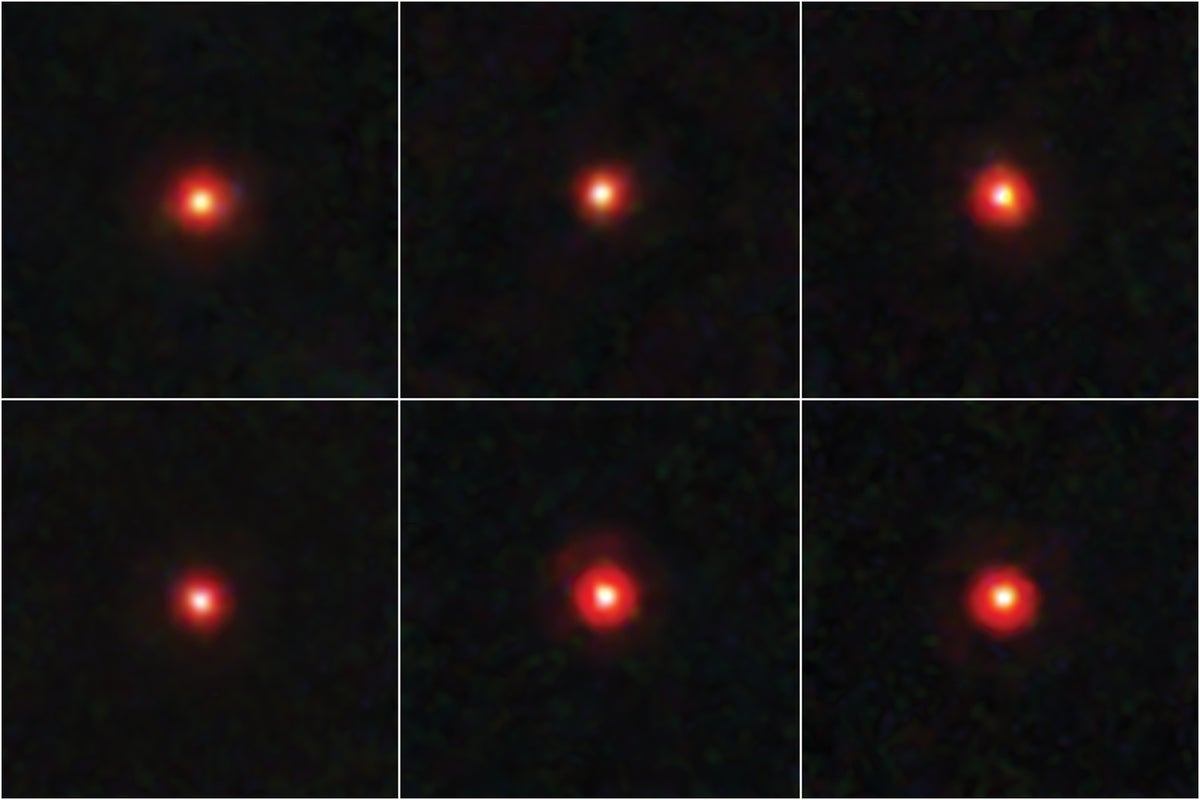
X-ray dot' discovery fuels JWST black hole star' debate

A newly found red JWST object emits X-rays, supporting the idea that little red dots are black-hole-powered, gas-enshrouded galaxies in the early universe.
fromWIRED
2 months ago

Could AI Data Centers Be Moved to Outer Space?

Now say you want to run some modest AI stuff. That's a bigger job, so let's scale up our cubical computer with edges twice as long as before. That would make the volume eight times larger (2 3), so we could have eight times as many processors, and we need eight times as much power input-2,400 watts. However, the surface area is only four times (2 2) larger, so the radiative power would be about 4,000 watts.
Science
Science
fromFuturism
1 month ago

Data Centers in Space Are Even More Cursed Than Previously Believed

SpaceX filed a patent for orbital data centers with up to one million satellites, but experts remain highly skeptical about financial feasibility and technological viability of space-based AI infrastructure.
fromBig Think
1 month ago

Record-breaking natural laser discovered 11 billion light-years away

an electron within a molecule gets excited to a higher-energy state, the electron de-transitions back to the lower energy state, where it emits light of a very specific wavelength in the process. Then, pumped or injected energy re-excites an electron within that very same molecule back into that higher-energy state, over and over.
Science
[ Load more ]