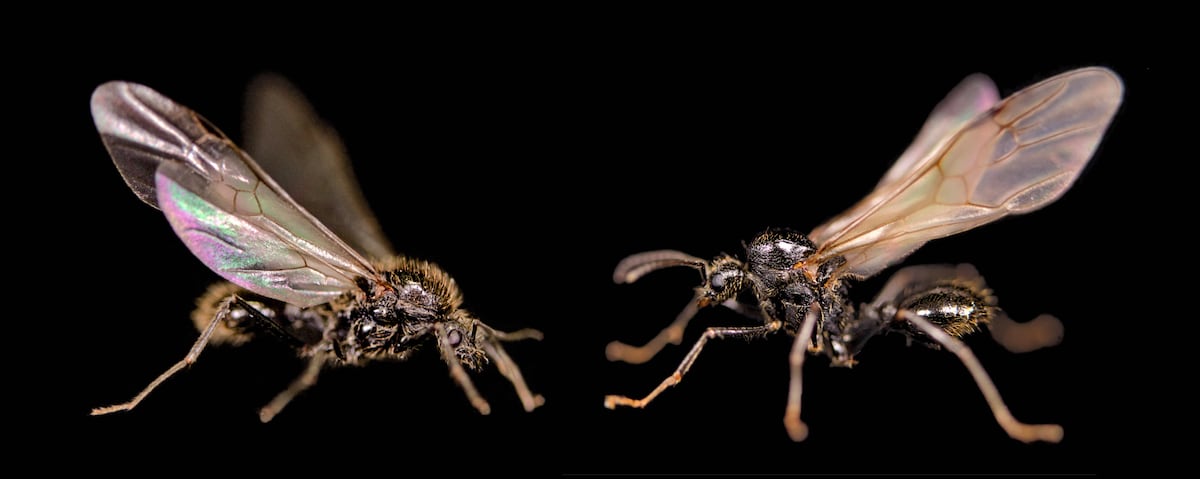
Crushed clean, dry eggshells, when scattered over the soil, are intended to stop adult gnats from laying eggs and potentially add natural fertilizer. However, they merely sit on the surface, collecting dust, while the gnats remain attracted to the damp compost.
A study by researchers at the University of California Berkeley has found that ethanol is surprisingly common in floral nectar, the sugary fuel that keeps pollinators alive. Yeast feeding on those sugars produces trace amounts of alcohol, and in this study, it showed up in 26 of the 29 plant species sampled.
Around a third of UK gardeners use pesticides, and our studies found that house sparrow numbers, for example, were nearly 40% lower in gardens where the pesticide metaldehyde was used. By reducing pesticide use, you can actively encourage birds back into your outdoor spaces, as they rely on invertebrates such as slugs and snails as natural prey.
Starting plants from seed extends your relationship with the garden, gives you more control over seed sourcing, and saves real money compared to buying nursery starts, sometimes as much as 90% per plant.
I'll be talking about holistic engineering or the practice of factoring in your technical decisions, designs, strategies, all the non-technical factors that are actually forces that influence your organic socio-technical problem space. As much as you can see in this canyon how natural forces have influenced the shape of the earth, so you can see the color. You can see all the different layers.
It's a big part of MCA. Our funding for wheat breeding is a big investment that we make on behalf of Manitoba producers and their check-off dollars. There's still going to be some ongoing. We're just trying to figure out what the effect these cuts are going to have on these programs and where we might have to step up.
For 30 years, InVigor hybrid canola has played a central role in advancing productivity and performance for canola growers around the world. This facility expansion marks the next chapter in that legacy, enhancing breeding capacity, integrating advanced automation, and accelerating the development of new hybrids.
If we did that today, it would be a hundred percent, because right now, without question, 2026 is riskier than 2025. So farmers really [face significant challenges]. The war in Iran continues and it works back to the world of agriculture. It's had an impact on fertiliser and diesel prices and commodity markets, as well as currency.
Biology is undergoing a transformation. After centuries of studying life as it evolves naturally, researchers are now using a combination of computation and genome engineering to intervene, generating new proteins and even whole bacteria from scratch. The use of artificial-intelligence tools to design biological components, an approach known as generative biology, is set to turbocharge this area of research. Just last year, scientists used AI-assisted design to produce artificial genes that can be expressed in mammalian cells.
Martschenko's argument is largely that genetic research and data have almost always been used thus far as a justification to further entrench extant social inequalities. But we know the solutions to many of the injustices in our world-trying to lift people out of poverty, for example-and we certainly don't need more genetic research to implement them. Trejo's point is largely that more information is generally better than less.
To an unimaginable eye, a seed looks inert. Yet they are packed with genetic information and biological processes poised to unfold. All it takes is the right configuration of signals and stimuli from the environment to let them know it's time to dare to grow.
"I've been with Syngenta for 28 years," Ramachandran says, noting that early travels across Canada shaped his passion for seed care. "What really stood out to me is seeing firsthand the passion, the resilience and the impact the growers made." Those experiences, combined with Canada's short growing season, continue to guide his work. "Everything that we have done... is around addressing those challenges, and how do we create solutions that are fit for purpose, for Canadian growers?"
As concepts such as "regenerative" and "biodynamic" continue to enter the mainstream coffee lexicon, scientists continue to literally dig into the soil to give them meaning. A recent peer-reviewed study from India's Western Ghats argues that one of the clearest signals of healthy, sustainable coffee farms lies in the ground itself, with organic coffee soils performing better than soils from conventional farms treated with synthetic inputs.
Yaghi describes AI not as a silver bullet, but as an advanced form of statistical pattern recognition-tools that can identify trends in data that may be difficult or time-consuming for people to uncover on their own. The real opportunity, he says, depends heavily on what farms are already doing. Operations that are consistently collecting and digitizing high-quality data are better positioned to benefit, whether the goal is lowering per-cow costs in a dairy, improving financial analysis, or identifying operational efficiencies.