Scala
fromMedium
3 days agoScala's Growth Model - Building Inward, Starving Outward
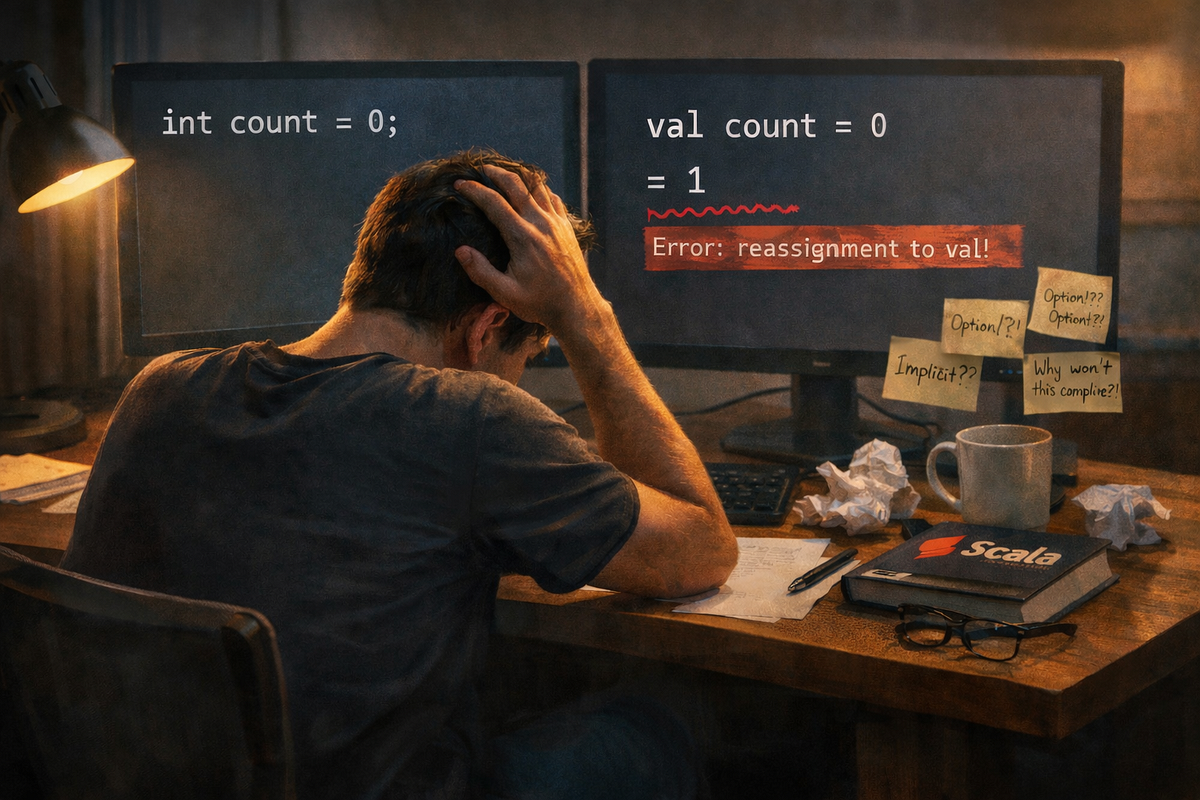
Scala's ecosystem excels internally but struggles to attract new users due to structural and cultural barriers.
React Native v0.85 introduces a new Shared Animation backend, enhancing the animation capabilities of applications. Upcoming features like <ViewTransition> and Skia Graphite promise to further improve user experiences.
Events are essential inputs to modern front-end systems. But when we mistake reactions for architecture, complexity quietly multiplies. Over time, many front-end architectures have come to resemble chains of reactions rather than models of structure. The result is systems that are expressive, but increasingly difficult to reason about.
When you assign the any type to a variable, you're essentially telling the compiler: Stop checking this. I'll handle it myself. At that moment, you've basically turned off TypeScript. Even worse, any tends to spread through a codebase. If a function returns any, every variable that receives that value becomes untyped as well.
Coding is simply the act of giving instructions to a computer. Those instructions are written in programming languages that follow specific rules, but at a beginner level, the focus is not on perfection or complexity. It is on learning how to think through problems step by step. Learning to code helps you: understand how websites and applications work break problems into smaller, manageable pieces think logically and clearly about processes build confidence through hands-on creation develop skills that transfer across many roles
Angular is a cohesive, all-in-one reactive framework for web development. It is one of the larger reactive frameworks, focused on being a single architectural system that handles all your web development needs under one idiom. While Angular was long criticized for being heavyweight as compared to React, many of those issues were addressed in Angular 19. Modern Angular is built around the Signals API and minimal formality, while still delivering a one-stop-shop that includes dependency injection and integrated routing.
One of my oldest open-source projects - Bob - has celebrated 15 a couple of months ago. Bob is a suite of implementations of the Scheme programming language in Python, including an interpreter, a compiler and a VM. Back then I was doing some hacking on CPython internals and was very curious about how CPython-like bytecode VMs work; Bob was an experiment to find out, by implementing one from scratch for R5RS Scheme.
A real Tetris loop has time (ticks), concurrent inputs (keystrokes), state transitions (collision, locking, line clears), and non-determinism (piece generation). In many imperative designs, these concerns end up tangled in shared mutable state, which tends to produce bugs that are: hard to reproduce (timing-dependent), hard to test (logic mixed with effects), hard to debug (replay isn't deterministic).