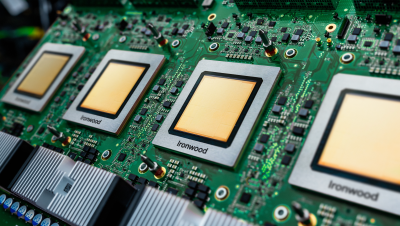
The AI revolution accelerated after 2023, driving applications from chatbots to autonomous systems and creating trillions in market value. Tech companies invested heavily in data centers and specialized hardware to support rising training and inference demand. Supply chain bottlenecks in advanced manufacturing, power constraints, and component shortages are emerging limits on growth. Advanced packaging capacity, especially Taiwan Semiconductor's CoWoS process that integrates processors with high-bandwidth memory, has become a critical choke point. Nvidia secured a majority of CoWoS capacity through priority allocations, constraining rivals. Alphabet reduced its 2026 TPU production target due to limited packaging access. Production queue competition at Taiwan Semiconductor is now shaping AI hardware scaling.
"Alphabet ( NASDAQ:GOOG )( NASDAQ:GOOGL ) has reportedly reduced its 2026 production target for Tensor Processing Units from around 4 million to 3 million units. According to a report by Korea Economic Daily, this adjustment stems from limited access to Taiwan Semiconductor's CoWoS advanced packaging capacity, which Nvidia ( NASDAQ:NVDA ) secured through priority allocations. CoWoS integrates processors with high-bandwidth memory on a silicon interposer, essential for high-performance AI accelerators. Without sufficient capacity, finished chips cannot deploy at scale. Other outlets have reported on production caps previously."
"The artificial intelligence (AI) revolution has expanded rapidly since 2023, powering applications from chatbots to autonomous systems and driving trillions in market value. Tech giants have invested heavily in data centers and specialized hardware to meet surging demand for training and inference tasks. However, constraints are emerging that cap this growth rate. Supply chain bottlenecks, particularly in advanced manufacturing, limit how quickly new AI capabilities can scale. Power availability and component shortages further hinder expansion."
"Taiwan Semiconductor dominates CoWoS technology, but explosive AI demand has outpaced its expansions. Nvidia has locked in over half of its available capacity through 2026 and 2027, leaving competitors like Google constrained. This forced Google to cut its production target despite strong internal needs for its custom silicon. The issue underscores how supply allocation now influences the AI hardware landscape more than design or demand alone."
Read at 24/7 Wall St.
Unable to calculate read time
Collection
[
|
...
]