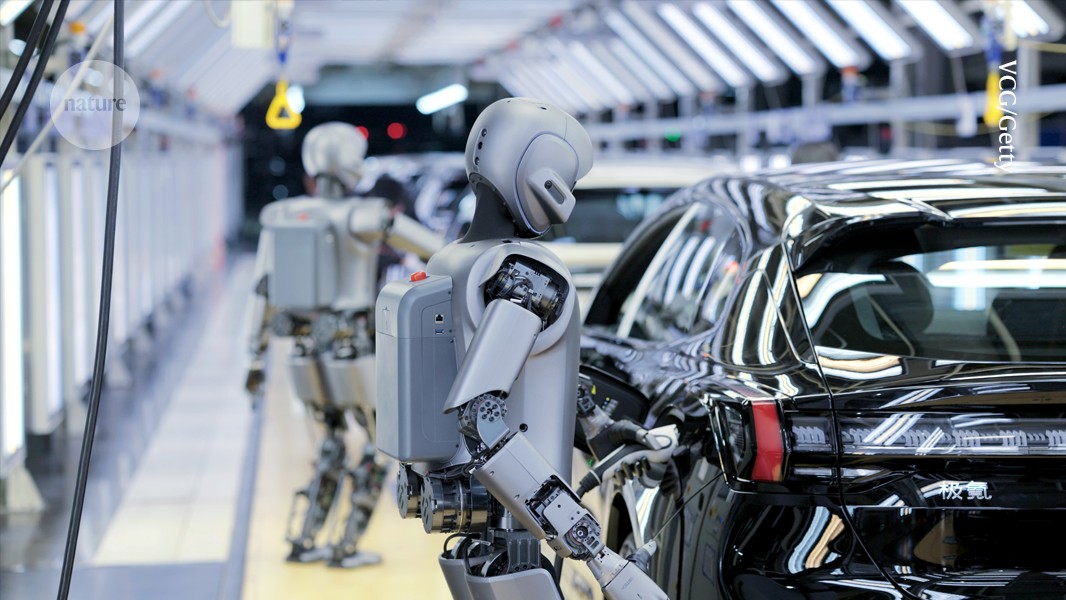
"Many researchers agree that there has been a step change in humanoid capability over the past five years, owing to cheaper parts as well as innovations such as improved battery power and artificial-intelligence algorithms, which allow for better perception and autonomy."
"In November, Chinese firm UBTECH announced that it had made "the world's first mass delivery of humanoid robots". More than 1,000 of its Walker S2 model humanoids were sent to factories in 2025, says Yu Zheng, a roboticist and vice-dean of the UBTECH Research Institute in Shenzhen. The silver-white humanoid can walk autonomously and stably, as well as grab and move objects, but deployment "is still at an early stage", says Zheng."
"Battery time is limited to hours and many activities still require human operators, who use the robots as puppets to complete tasks while gathering data for future iterations. Other researchers caution that technical and safety limitations mean that humanoids are far from ready for general-purpose use in homes and offices. "They can do maybe one or two things autonomously, or semi-autonomously," says Esyin Chew, a roboticist at Cardiff Metropolitan University in the United Kingdom, who is overseeing a project involving trialling more than 80 robots in service and health-care settings. "But they cannot react to real-world problems like our human brains," she says."
Humanoid robots have improved significantly in recent years due to cheaper components, better batteries, and advances in artificial-intelligence algorithms that enhance perception and autonomy. Over 1,000 Walker S2 humanoids were delivered to factories in 2025, and the model can walk autonomously, grasp, and move objects, though deployment remains at an early stage. Battery life is limited to hours, many tasks still require human operators who puppet robots to collect training data, and current systems perform only one or two autonomous tasks. Technical and safety limitations prevent general-purpose use in homes and offices at present.
Read at Nature
Unable to calculate read time
Collection
[
|
...
]