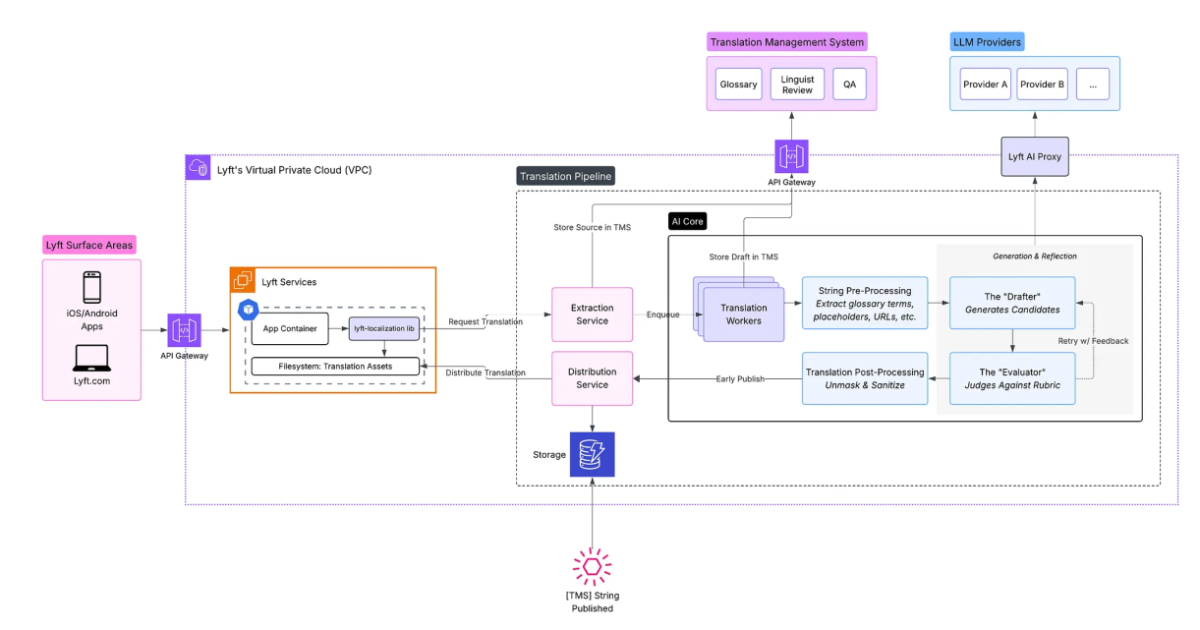
Lyft has developed an AI-driven localization system to improve the translation of its app and web content, facilitating international growth while ensuring quality. The system processes 99% of user-facing content through a batch translation pipeline, achieving a 30-minute service level agreement for 95% of translations. It integrates large language models with human review to enhance speed and consistency. The dual-path architecture allows for immediate use of AI-generated translations, while human linguists ensure quality through asynchronous reviews and iterative refinements.
"Lyft's new localization system processes roughly 99% of user-facing content through a batch translation pipeline, targeting a 30-minute SLA for 95% of translations."
"The system integrates large language models with automated evaluation and human review, enabling faster turnaround while preserving consistency in tone, style, and legal messaging."
"The batch translation pipeline follows a dual-path architecture, submitting source strings to a translation management system for human oversight and to LLM-based workers for rapid draft generation."
"Context injection, including UI metadata, placeholders, and regional considerations, guides translation quality, while deterministic guardrails enforce safety, legal, and compliance standards."
#ai-localization #translation-technology #international-expansion #large-language-models #quality-assurance
Read at InfoQ
Unable to calculate read time
Collection
[
|
...
]