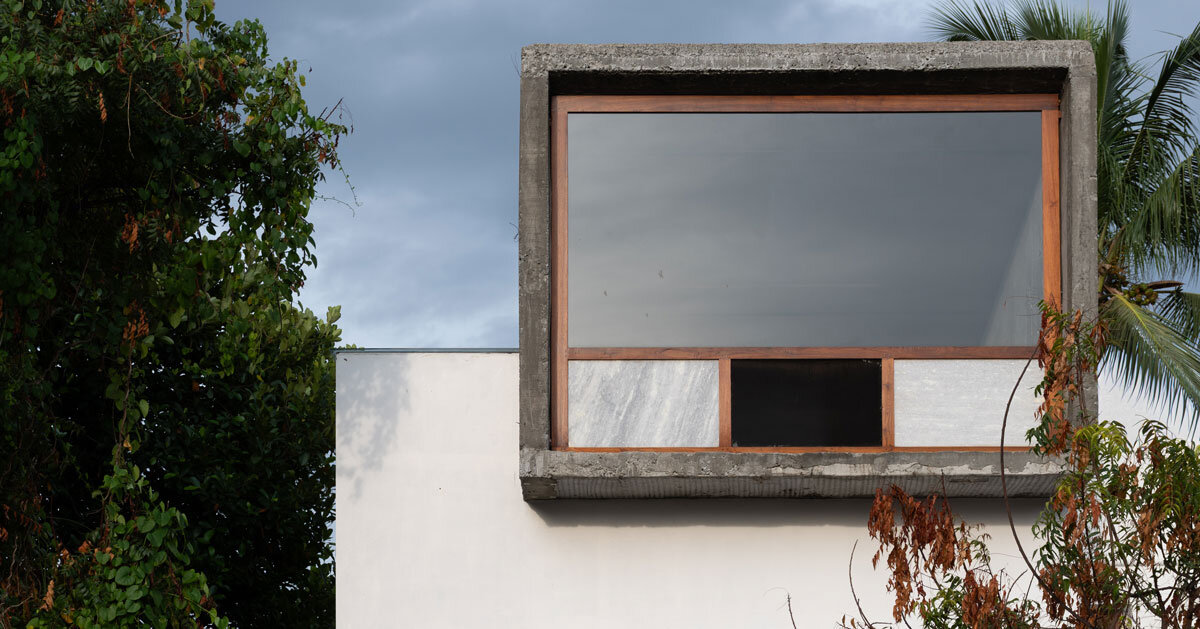
"Built on the site of the client's childhood home, the 3,200-sqft house is conceived as an architectural framework shaped by memory, landscape, and lived experience rather than by a predefined stylistic approach. The design translates recollections of place into spatial sequences, organizing the house around four distinct architectural narratives, or 'tales,' each derived from specific experiences associated with the land."
"Instead of imposing a singular formal language, the design allows spatial volumes to emerge from remembered relationships between built form, movement, and landscape. The resulting house operates as a layered environment where memory informs material choice, spatial proportion, and environmental strategy. all images courtesy of Studio for Architecture and Regional Urbanism (SARU) Four Spatial Tales organize the house's program The first spatial sequence interprets childhood experiences of movement through garden paths, grass trails, and shaded thresholds."
Tales of Saru is a 3,200-sqft residence at the Nilgiris foothills built on the client’s childhood property. Memory, landscape, and lived experience form the primary organizing principles rather than a predetermined stylistic approach. The house arranges program around four spatial tales derived from specific land-related recollections. Regional climate, vegetation, and topography directly inform material choices, spatial proportions, and environmental strategies. Spatial volumes arise from remembered relationships between built form, movement, and landscape, producing layered environments. A linear courtyard, filtered daylight, layered planting, and fixed built-in seating mediate climate, movement, and bodily connection to structure.
Read at designboom | architecture & design magazine
Unable to calculate read time
Collection
[
|
...
]